
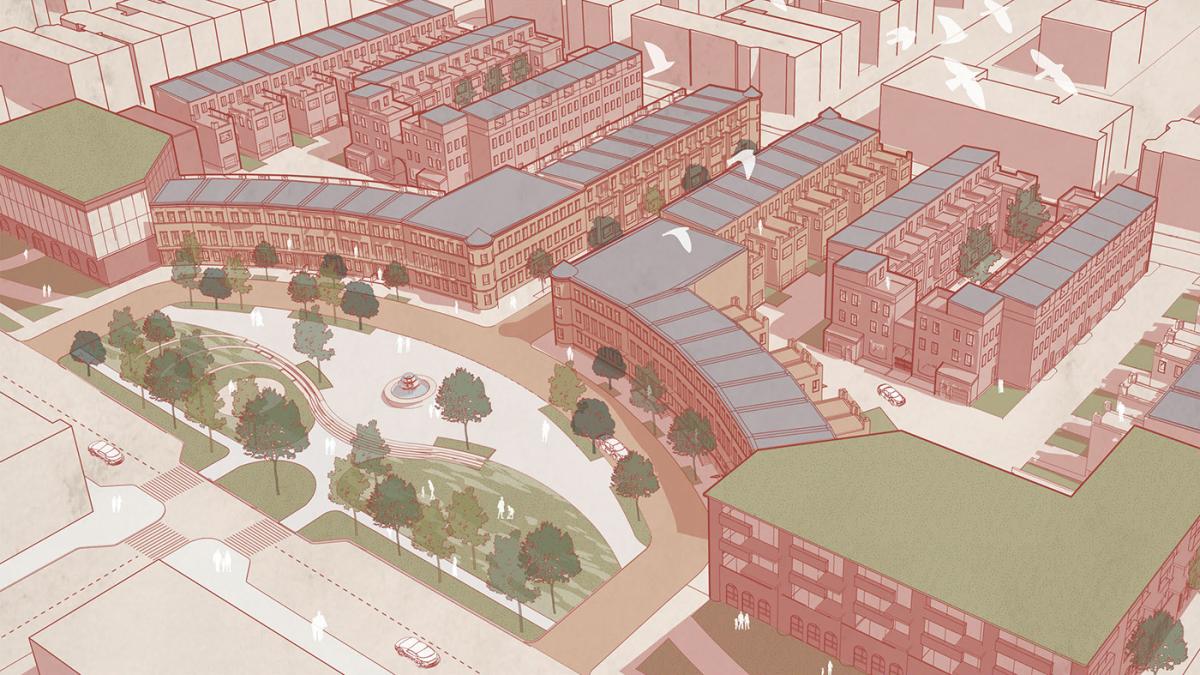
A design proposal by University of Maryland graduate students to unify two Baltimore neighborhoods historically divided by redlining and disinvestment earned top honors in the 2026 Congress of the New Urbanism (CNU) Charter Awards.
“Madison Crescent,” which transforms a vacant parcel into a community-centered, amenity- and housing-rich linear park, was one of two student projects honored in the national competition, which recognizes outstanding concepts in new urbanism—walkable, “human-scale” communities that intertwine housing, retail and civic amenities.
Developed by Makenna Benson M.Arch. ’27, M.H.P. ’27, Lauren McNamara M.Arch. ’26 and Shannon Sinnicki M.Arch. ’26, the project was one of seven schemes conceived during a 2025 urban design studio sponsored by the Maryland Department of Housing and Community Development to generate new development ideas for vacant sites in Baltimore that support existing residents, bring needed assets and walkability to communities, and amplify the storied architectural history of the city.
“I always tell my students that the first step in sustainability begins with reinforcing existing assets like streets, parks, schools and community-supporting infrastructure like retail and transit,” said Matthew Bell, FAIA CNU, who led the studio. “These projects help to envision how historic communities can grow by adding new residents, diversifying housing stock and creating places that future generations will come to greatly value.”
A vacant elementary school and community center added during 1960s urban renewal currently stand on the 6-acre site, which straddles the Bolton Hill and Madison Park neighborhoods. It was one of several areas where the city built over existing roads—in this case, Madison Avenue—to lengthen city blocks, but which ultimately cut off the corridor from vehicles and pedestrians, increasing traffic on neighboring streets.
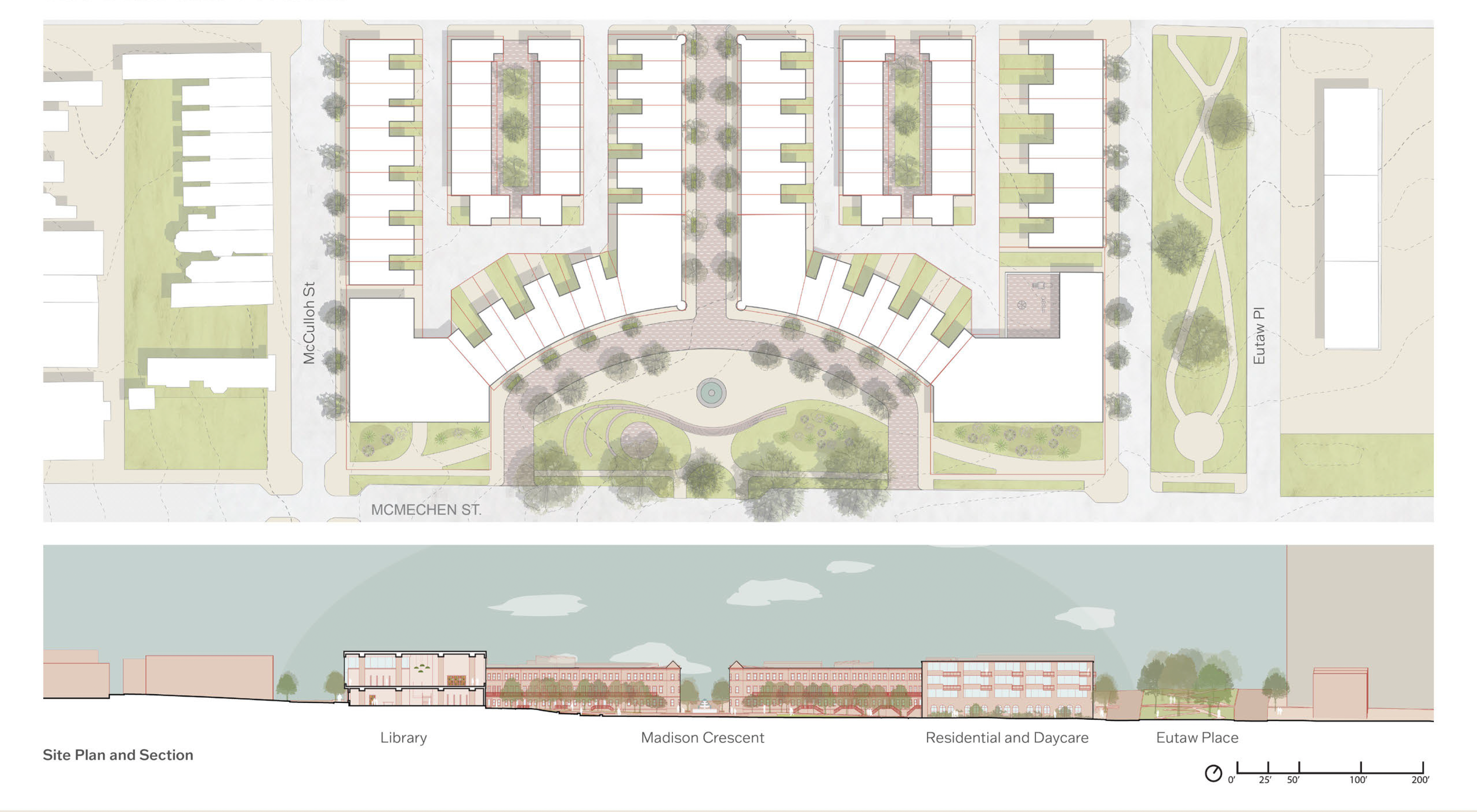
The team’s design scheme reconnects Madison Avenue to create an accessible and quiet pedestrian boulevard anchored by an expansive, crescent-shaped public space, similar to landmarks in London or Paris. The green corridor provides a punctuated sense of place and focal point for the community.
While much-needed civic and retail amenities—including a library and daycare—bring new opportunities to residents, new housing is front and center: A mix of apartments and smaller rowhomes offer an alternative to the traditional—and more expensive—three-story Baltimore walkup prevalent in the area. “Mews,” or smaller, single-family rowhomes, cluster around secured traffic-free courtyards.
Smaller and more diverse housing stock, said McNamara, was a real need for residents and Maryland Institute College of Art students living in the area to provide a pathway to homeownership there.
“This project really helped my understanding of urbanism, but also how real estate development plays a role in design,” she said. “I hadn't really thought about having smaller houses available to buy and how that changes the neighborhood versus renting.”
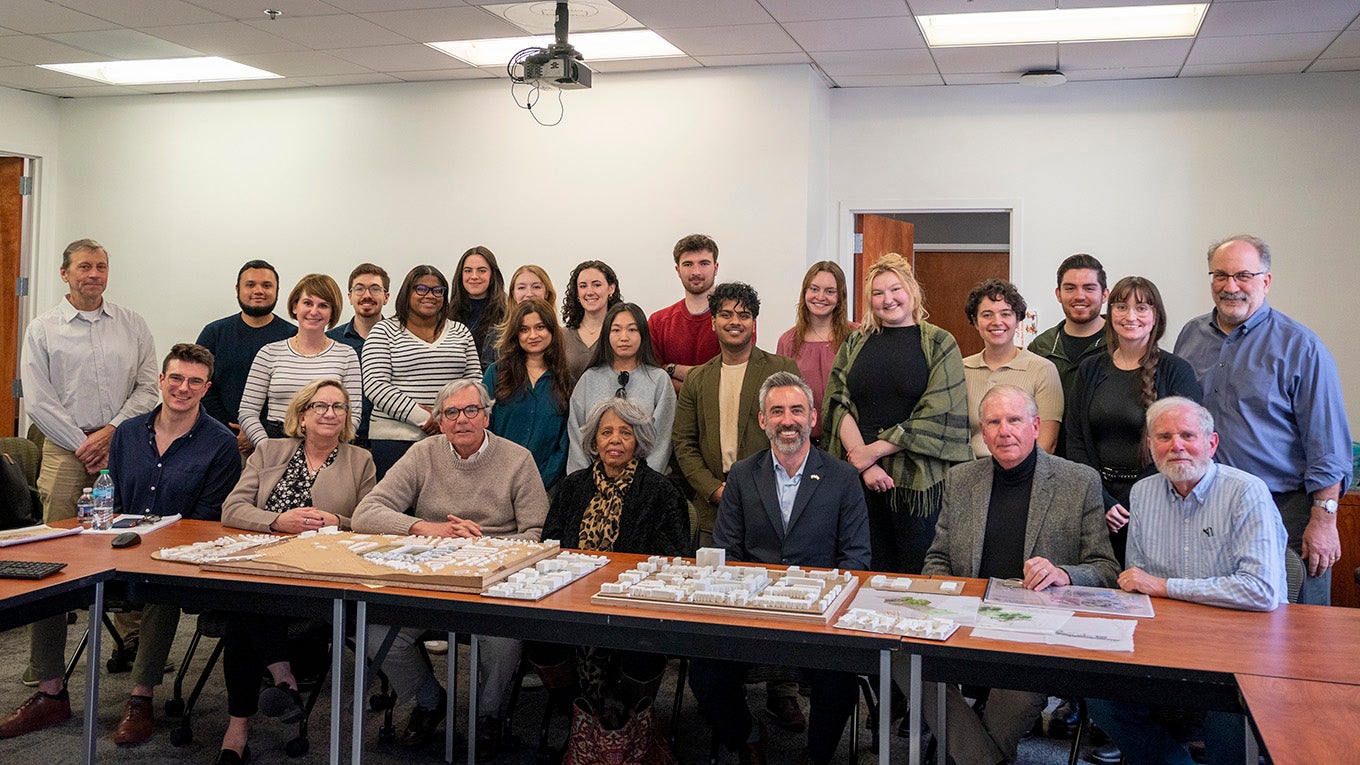 The team presented their plans to Secretary of Housing and Community Development Jacob Day ‘04 and Carol Gilbert M.Arch. ’92, director of neighborhood revitalization for the Maryland Department of Housing and Community Development, in the spring; plans are also being shared with the community and will be used to kick-start ideas for developing the parcel. Sinnicki said that tapping into community members’ experiences through listening sessions, coupled with Bell’s knowledge of the area’s history and of urbanism, were key to creating plans that nurture the existing neighborhood through healthy urban development.
“We were given this huge problem of vacancy in Baltimore, which seems almost unapproachable,” she said. “But what we learned is that if you do it carefully, you can truly achieve neighborhood revitalization that won't feel like gentrification. That can be healthy, slow growth for the local residents. And I felt like that was really important.”