
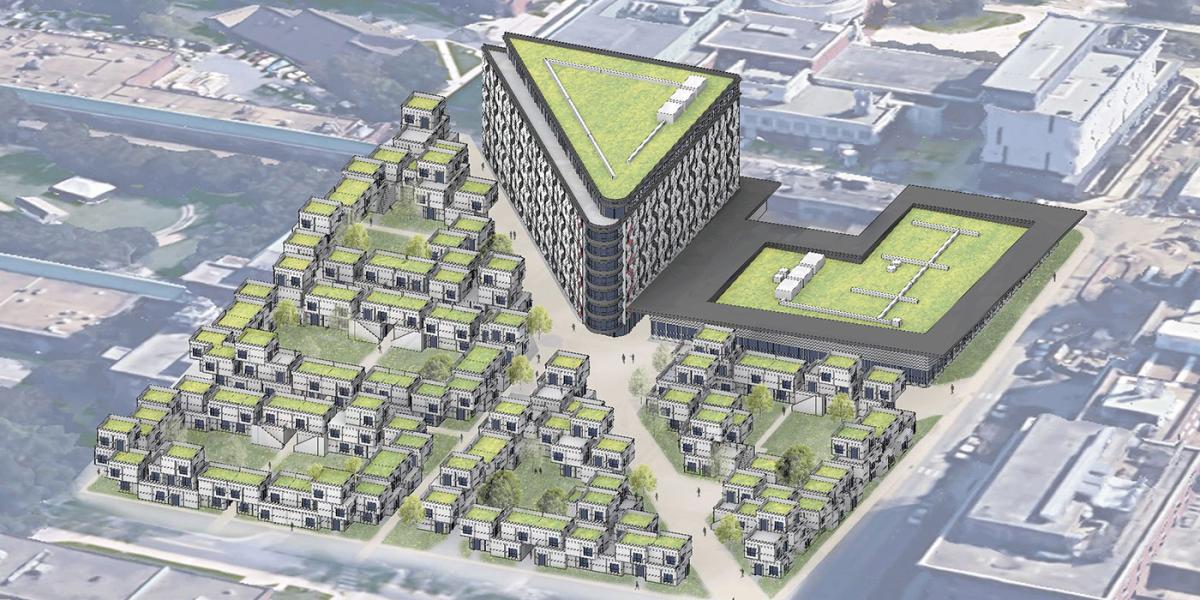
A proposal for modular, living-learning “innovation villages” on the northeast corner of University of Maryland’s campus cemented a victory for two University of Maryland undergraduates in a national design contest.
For a second year, UMD architecture undergraduate students swept first, second and third place in the second annual Precast/Prestressed Concrete Institute (PCI) Design Precast, beating 39 other teams all tasked with conceiving a 200,000-square-foot living-learning community on the student’s home campus that showcases the structural integrity, sustainability and versatility of precast concrete. The students presented their winning designs to industry leaders last month at PCI’s annual convention in Kansas City, Mo.
Known for its durability, efficiency and sustainability, precast concrete can be found on nearly every street corner, from high-rises and big-box stores to parking garages and schools. Walls, beams and other construction components are manufactured in large molds in a factory and then delivered on site, significantly cutting curing, assembly and construction time.
PCI’s competition was conceived by UMD architecture Associate Professor Michael Carlos Kleiss in 2023 while at Clemson University to encourage architecture students to rethink the material’s application in a creative way. For the past two years, he’s shared his expertise in structural and computational design with UMD architecture students through hands-on—and award-winning—project work.
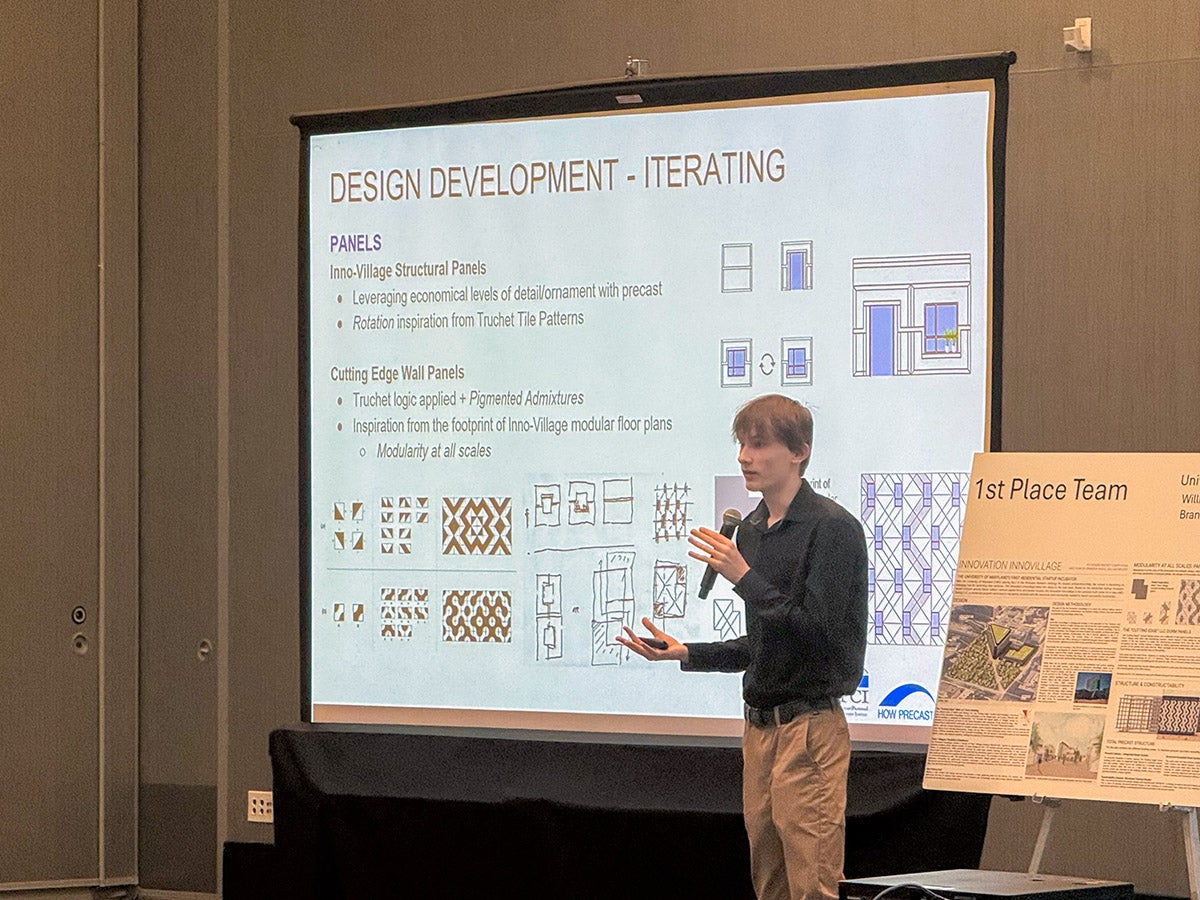
“I’ve never taken such a deep dive into a single building technology,” said William Walker ‘28, who won first place with Brandon Bosaz ‘28. “We did an incredible amount of research and prep for our project. Then we spent three days in basically the capital of concrete with the most knowledgeable people in precast, which we may never get to do again.”
Their design, Innovation Innovillage, includes clusters of modular student housing reminiscent of Silicon Valley’s hacker houses, fostering entrepreneurial communities for upperclassmen and graduate students near the campus’ engineering and science corridors. A built-in structural system and repeated, artistic panels gave the team an integral and creative edge.
“A strength of precast is that you can really mold it to whatever you want, and the structural aspects can also be your aesthetic ones,” said Bosaz.
Maryland’s second-place win, a cantilevered concept by Andy Huynh ’28, Thach Pham ’28 and Kevin Xu ’27 stacks two curved structures atop each other in a Y shape to create community spaces both at the ground level and on an expansive rooftop. The students devised a single master mold that offers three configurations for panels, from solid to window encasements, which were mixed to create a visually dynamic project. Abby Heng ’28, Bonnie Tran ’28 and Catlinh Tran ’28 took third place.