
This article originally was published in Terp.
AN AIRPORT’S MOVING walkway offers a window into the spectrum of human emotion in motion: the exhaustion of a mother placating her toddler with M&Ms; the collective fury over a canceled flight; the apathy brewing in a stagnant queue at Starbucks.
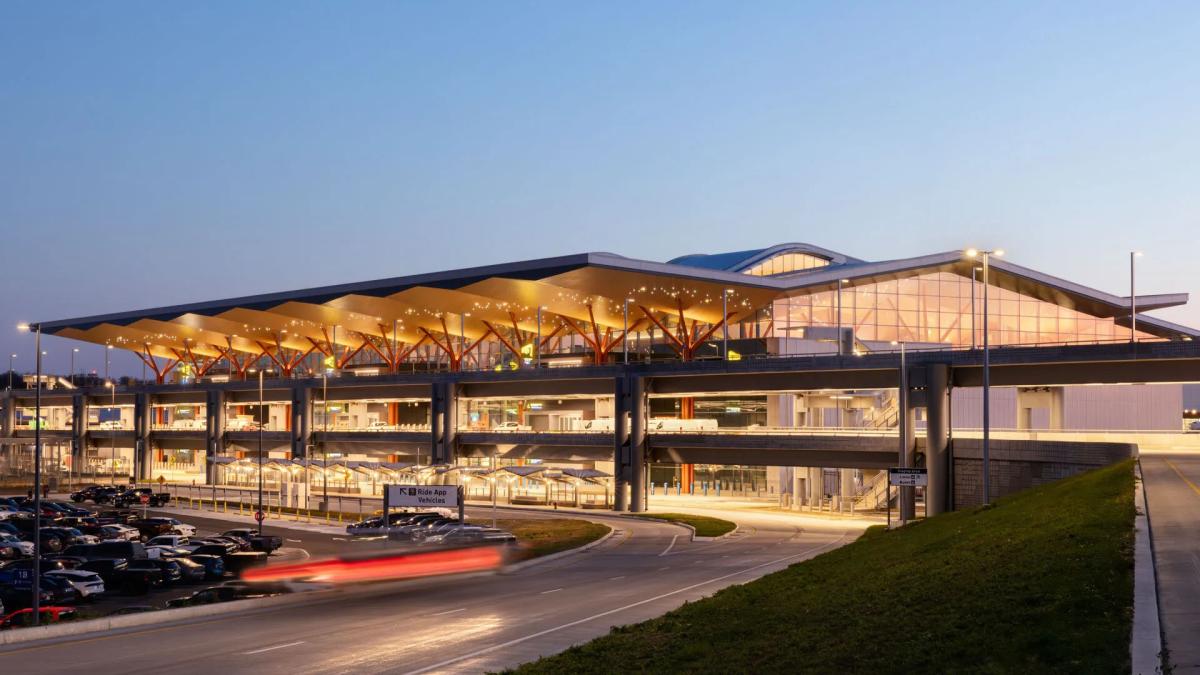
But when architect Charishma Hunjan ’13, M.Arch./MRED ’15 was designing a new terminal for Pittsburgh International Airport, her team drew inspiration from another shared sentiment—the joy of reunion.
In Pittsburgh, it’s personified by the city’s “meeter-greeter” culture: throngs of people with homemade signs waiting in baggage claim.
“We wanted to take that little nugget, which is such an important experience for this community, and create something amazing,” she says.
An architect for the past decade with the global design firm Gensler’s aviation practice, Hunjan has spent a lot of time in airports. Her teams were behind Toronto Pearson International Airport’s Terminal 1 expansion, the upgrade at Syracuse, N.Y.’s international airport and the new terminal in Pittsburgh. Her latest project, the glassy, butterfly-shaped Terminal 1 at New York’s JFK Airport, is slated to welcome flyers this summer.
“Airport architect” is not the career most students dream of, but Hunjan had a clear runway: Her thesis at Maryland was a new scheme for Seattle’s SeaTac International Airport, a slow-burn idea lit her senior year after a dismal trek to her gate for an education abroad trip.
“It was this long, unending hallway and really miserable,” she recalls. “I kept thinking, ‘Am I going the right way? Why are there no windows? Is that the same Cinnabon?’”
Hunjan had picked architecture as a major for its power to impact people; she’d design an airport for its ability to bring them together.
“I wanted to create a place that offered these shared experiences for people, regardless of where they’re from,” she says. “And I thought, what is that? Well, an airport.”
Hunjan flexed her newly acquired real estate development skills to navigate what’s akin to building a small city. But when she realized she was in over her head, a former classmate connected her with Ty Osbaugh, a principal at Gensler who oversees its aviation practice.
“She just blew me away with the amount of rigor she put into it, and she continues to put so much thought into her work,” says Osbaugh. “I’ve told her this point blank: She’s the future of Gensler aviation.”
It’s about creating space to enjoy the moment. And why can’t that happen at an airport?
—Charishma Hunjan ’13, M.Arch./MRED ’15
The complexity of designing airports isn’t juggling the traffic patterns of large, steel birds or the myriad technical aspects, he says; it’s the thousands of stakeholders with no shortage of opinions. Hunjan, he says, is adept at working with the developers, investors, airport authorities, vendors and others with a quiet confidence.
“It’s a building type that challenges everyone, and every day is a little bit of a fight,” he says. “I thrive on her calmness.”
Tranquility isn’t an emotion easily channeled into the travel experience, but Hunjan says certain design elements can soothe and provide predictability. Simple, linear movement from security to the gate helps the hurried traveler, while abundant windows, calming natural light and clear signage help the harried one.
Once travelers off-ramp, they’ll find opportunities for different types of experiences in Hunjan’s designs, from welcoming corners to gather gate-side, to a traffic-stopper piece of art in the arrivals area.
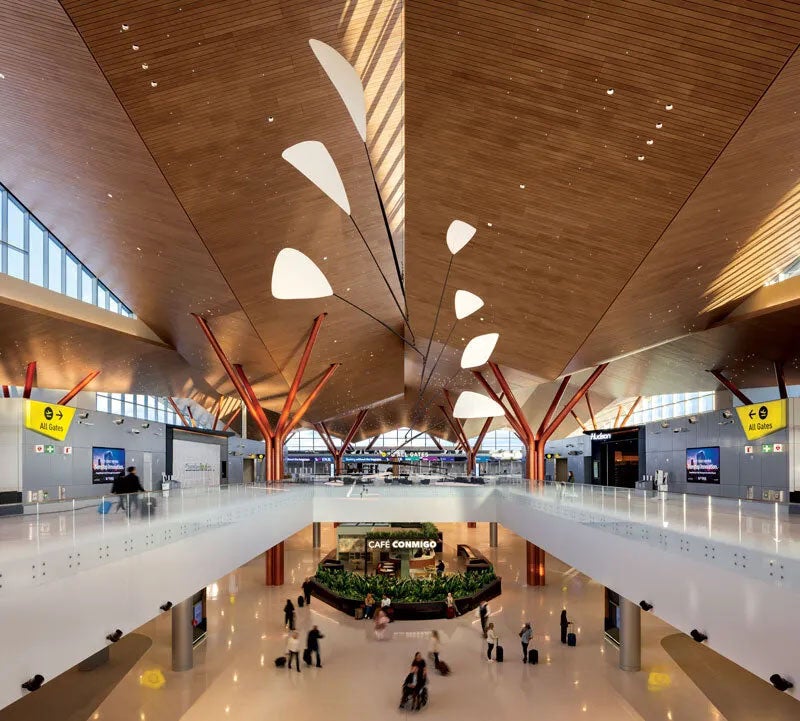
In October, an open house gave the Pittsburgh community its first glimpse of the airport’s new meeter-greeter hall, its expansive reception area capped with a vaulted wood ceiling inspired by Western Pennsylvania’s forests and hoisted by sleek steel “branches.” It’s a far cry from the terminal’s nondescript concrete lobby that previously welcomed weary travelers.
“When I think about the places I’ve been, I think of moments—it’s not always about the whole building,” says Hunjan. “It’s about creating space to enjoy the moment. And why can’t that happen at an airport?”