
Associate Professor Joseph Williams has delivered hundreds of lessons at the University of Maryland, but only once was he the one who got schooled. The historian had just finished a lecture on medieval architecture when one of his students approached him to graciously correct a reference he’d made to Orthodox Christian liturgy.
Although an undergraduate, the young woman had it on good authority—after all, she had dedicated her life to the faith as an Orthodox nun.
“She of course was right,” recalls Williams. “But what struck me was just how engaged and how seriously she took the class.”
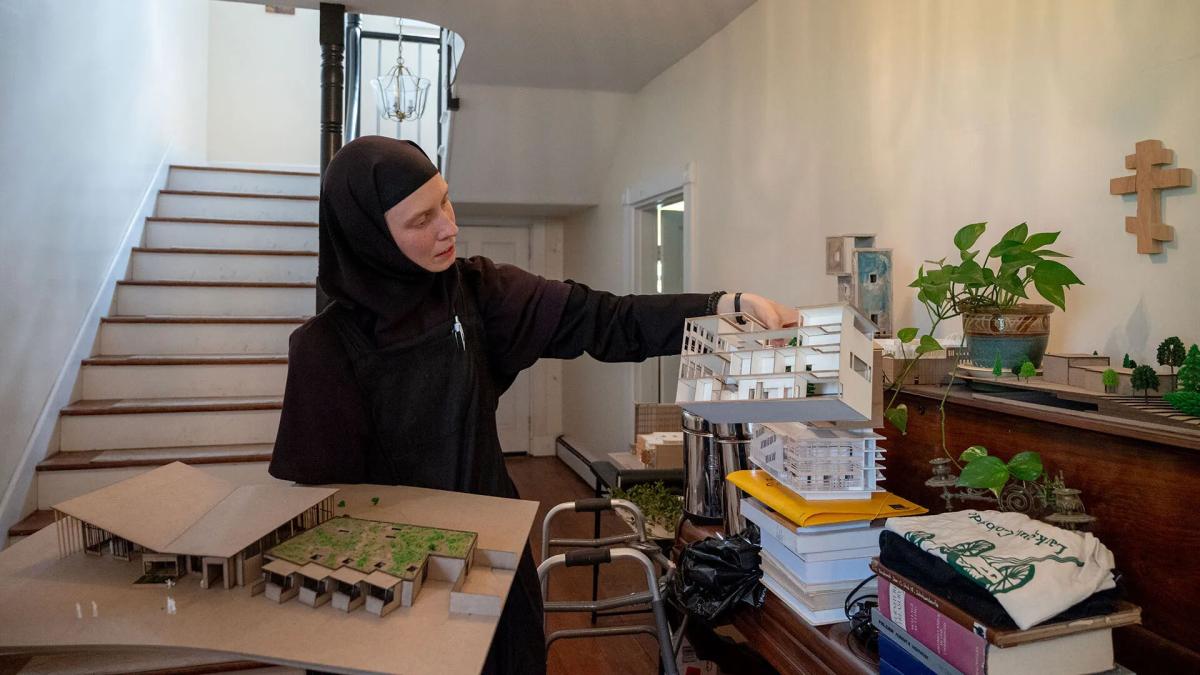
The encounter led to many discussions during Williams’ office hours and eventually a report on Orthodox baptistries, yet it wasn’t Sister Nina’s most important assignment at UMD. That came from her spiritual guide, Elder Dionysios: Learn the design skills necessary to help shape a future (and start ticking off a lengthy to-do list) for their growing monastic community in Frederick County. On Tuesday, Sister Nina will don a graduation robe and mortarboard over her monastic habit and walk with her classmates at the School of Architecture, Planning and Preservation’s commencement ceremony to receive a Bachelor of Science in architecture.
Sister Nina found her place at the Sacred Monastery of Saint Sidónia, part of the Patriarchate of Georgia, after tagging along on visits with her father, a lawyer, who was consulting on the land purchase. Raised in a conservative Orthodox household, she volunteered to help around the developing monastery property and over time, got to know the sisterhood. One evening heading “home” from work, she realized that she’d instinctively taken the exit for the monastery, rather than her parents’ house.
“It wasn’t immediately clear what it meant, but at some point, it soon became clear that the monastic vocation is what I needed,” she said. She joined Saint Sidónia as a novice on Christmas Day 2014.
Her path to Maryland’s architecture program began with, quite literally, a blessing—a “design intervention” bestowed on Sister Nina after her knack for spatial awareness and creating plans caught the eye of the abbess. Their property, located about 12 miles northeast of Frederick, was large and the monastery was growing, she said; an architectural education would greatly benefit the monastery as they made plans for the future.
“In the monastery everything from the prayer services, to the daily program of works, to the architecture, supports the divine liturgy. The architecture is designed to provide exactly what is needed for every detail of the community life, so that everyone can focus on the prayer and services, as well as hospitality,” said Sister Nina. “How good, if all architecture were designed starting with the principle, the mindset of supporting the users to do what they are there for.”
She earned her associate’s degree at Frederick Community College before transferring to Maryland in 2022. She was a frequent fixture in the architecture program’s design studio and the library, and fiercely participatory in class, so much that, aware of her verbosity, she began asking her professors how often she should be raising her hand when they posed a question. Most faculty had never been asked that question before (one replied, “count to 10 first”).
“All the faculty wanted Sister Nina in their class,” said Associate Clinical Professor Julie Gabrielli. “She was just a really good student.”
In most design courses, she persuaded her professors to let her reinterpret assignments so she could pursue projects still rooted in the same lesson, but of use to the monastery. While her classmates worked on a spa in Georgetown, she envisioned a different kind of retreat, equally centered on health and wellness, but also a much-needed gathering space for the sisters of her monastery. In a required professional writing course, the professor allowed her to morph a project management assignment into the creation of a maintenance manual for the monastery, from the type of filters used for the HVAC system to how to operate the water shutoff.
“I’m a nun and my program is not typical,” she said. “But one thing I found is that the professors care about their students, and most of them are happy to work with students, as long as the student engages and wants to.”
Sister Nina’s university experience was rewarding, but not always easy. She commuted daily over an hour in each direction, leaving as early as 6 a.m. and often arriving home after 9 p.m., because of evening design studio, a requirement for the program. She frequently taped lectures and would re-listen to them on her drives. She concedes that encountering a nun in full monastic garments is not an everyday thing at a public university, and accepted the curiosity of her classmates and professors with humility. But she said she enjoyed collaborating with her peers and the rich conversations with her professors, whether about a studio project or Byzantine architecture.
The skills she learned are already manifesting at the monastery, which, in addition to prayer, daily services and hospitality, roasts coffee (with the slogan, “Nun Better”), makes lanolin products from its flock of sheep and hosts a summer camp for over 100 children each year. She is currently contributing to the development of the property’s master plan and has taken on smaller design projects like the addition of a greenhouse and a wheelchair ramp, and complete renovations of existing spaces, using concepts gleaned directly from studio projects.
“My hope [for Sister Nina] is that she discovered that there are limitless possibilities, even within a framework of rules and systems,” said Williams. “And life is not reduced to rules.”