
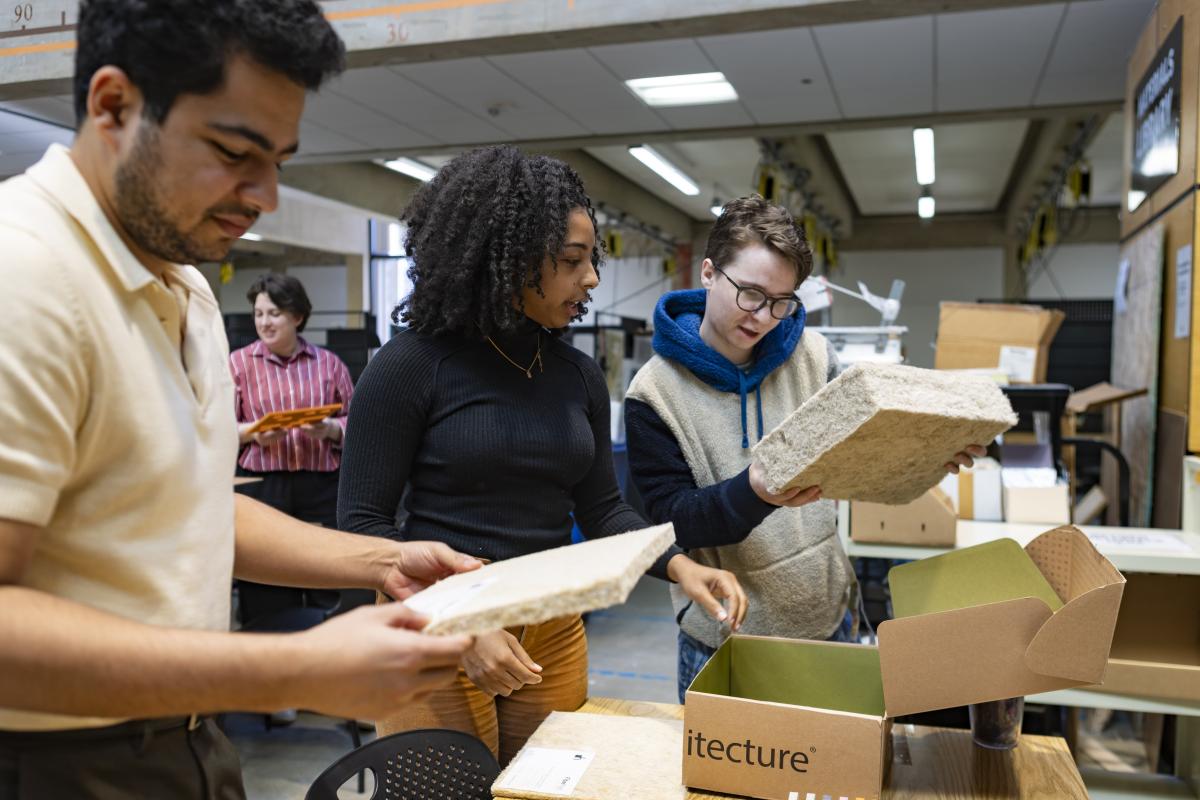
You won’t find the holdings at UMD’s newest library on any course reading list. But you might find them lining the walls of Cole Field House, pouring natural light into A. James Clark Hall or underfoot at the Stamp Student Union. They are speckled, squishy, textured and beautifully transparent — and the perfect resource for students with designs on crafting beautiful spaces.
The Materials Library is the University of Maryland Libraries’ newest sanctioned campus institution, one dedicated exclusively to building materials: foil-flecked acoustic paneling, heat-reflecting siding, rubber floor matting and a miscellany of exterior glass. Launched this fall in the School of Architecture, Planning and Preservation (MAPP), it’s the most hands-on library on campus, helping students envision their building designs in all of their fabricated glory.
Architecture Librarian Cindy Frank and Library Coordinator Hannah Parker put the idea into circulation after Frank attended a conference for the Association of Architecture Librarians and Archivists and learned how a colleague launched her university’s materials library simply by cleaning out a storage closet.
“I came back to Hannah and said, ‘I think we might be able to do this,’” said Frank.
Parker stealthily reconnoitered University of Pennsylvania’s arts and architecture library a few months later, while Frank gathered support from library and school administrators. The team began amassing materials over the summer; as it turns out, manufacturers are more than happy to send samples for free. Graduate assistant and architecture student Alexis Joseph doggedly solicited dozens of companies and created an inventory system for easy tracking.
Libraries held the soft opening in early September. Like the building's design studio and larger library, the materials library is available to students 24/7.
“It’s radical accessibility, but it reflects the culture of the school as I’ve come to learn it,” said Parker. “You don’t have to make an appointment. You don’t have to wear special gloves to handle items. You can just walk by whenever and grab something.”
Roughly 30% of university architecture programs in the country have some form of materials library; before UMD’s took shape, students’ only access to building materials was a hodge-podge of samples assembled by faculty and relegated to a pushcart in the corner of the design studio.
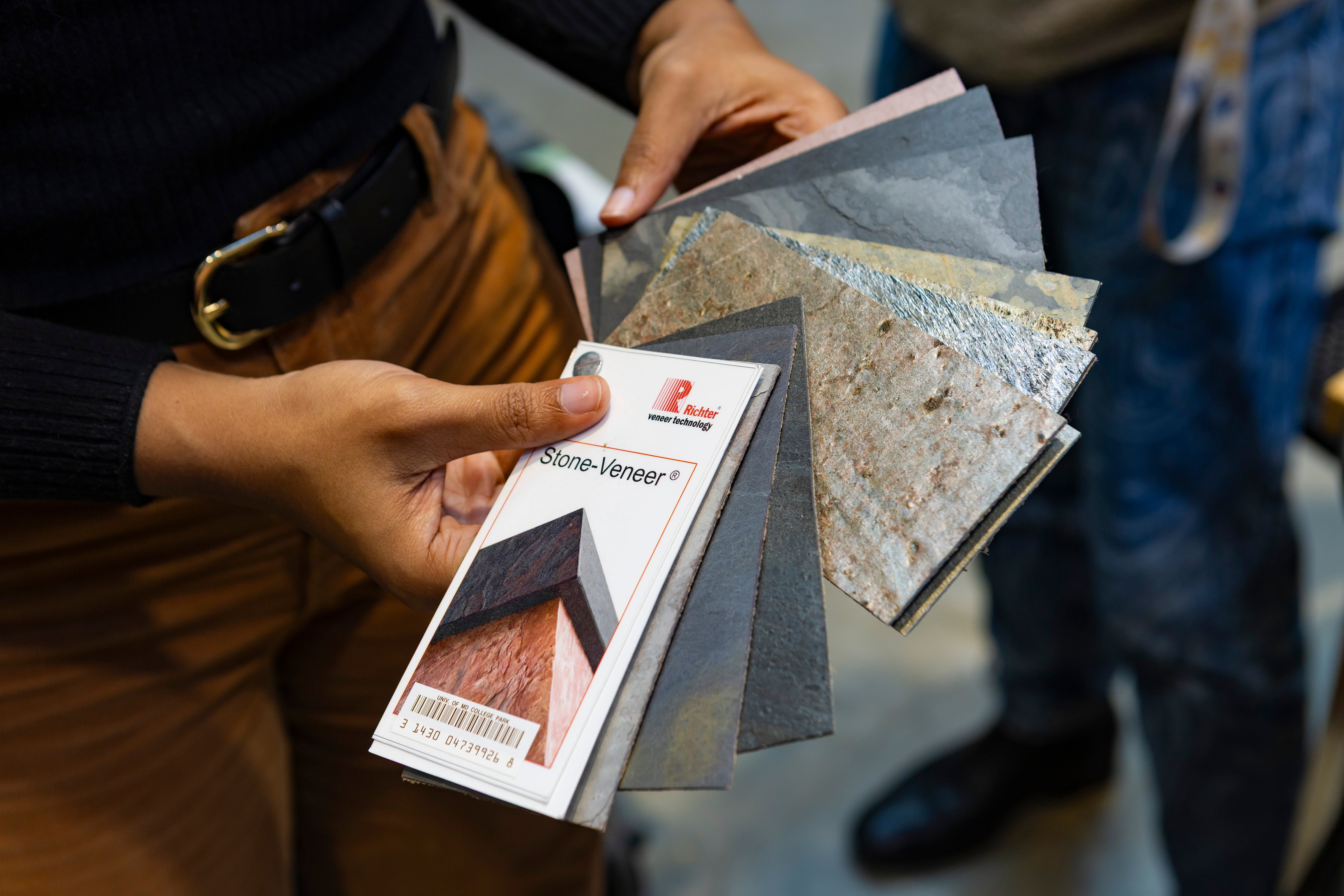
The new collection is six racks and growing, a “please touch” playground by design. Unlike McKeldin and Hornbake libraries, the stuff in these stacks beckons students to rub, squeeze, pile up and take back to their desks (there is no formal checkout process). Materials are organized by category, from finishes and glass to plastic composites and masonry. The collection includes square-foot samples of bird-friendly glass, blocks of wood paneling in a spectrum of brown hues, wavy metal sheathing and a deck of playing card-sized acoustic felt. Students can also explore the latest in sustainable products, from a mushroom-infused composite to sheep’s wool insulation.
“I’ve discovered a lot of nontraditional items I wouldn’t have known about, and it's definitely changed how I approach my projects,” said architecture graduate student McKayleigh Morter. “When I’m not sure what I want my building to look like, that’s a space I can explore, and maybe do something really different.”
Looking for a material not in the collection? Need to borrow the sheep's wool insulation for a project presentation? Accidentally drop the glass sample? (Frank insists you won’t be in trouble.) A sheet of QR codes allow students to communicate directly with library staff.
“The only thing we ask is that they just bring it back,” said Frank, nodding to the “returns” cart off to the side.
Access to different types of glass, stone, insulation and more helps students contemplate how their building will be constructed inside and out, said Frank, who had a career as a practicing architect before returning to UMD.
“It’s definitely preparation for the working world,” she said. “Whether you're in architecture or construction or preservation or real estate, having familiarity with materials, how much they cost and how they perform is incredibly helpful for realistically putting a building together.”
The library is currently open to MAPP students, but Frank and Parker are open to library hours for other schools in the near future. Long term, they hope to create an adjoining lab where students can actually test the material through fabrication to see how it performs.
A building, Frank and Parker agreed, is more than the activities happening inside; it’s a multisensory experience that, when done well, is worthy of exploring more deeply. With a large chunk of design today happening on computer screens, the materials library is an analogue departure, but one worth checking out.
“A lot of students can be apprehensive about libraries in general, but the whole point is for them to use it,” said Parker. “So if they ever feel doubt, if they're ever standing around here wondering, ‘Do I belong here?’ It's for them.”