
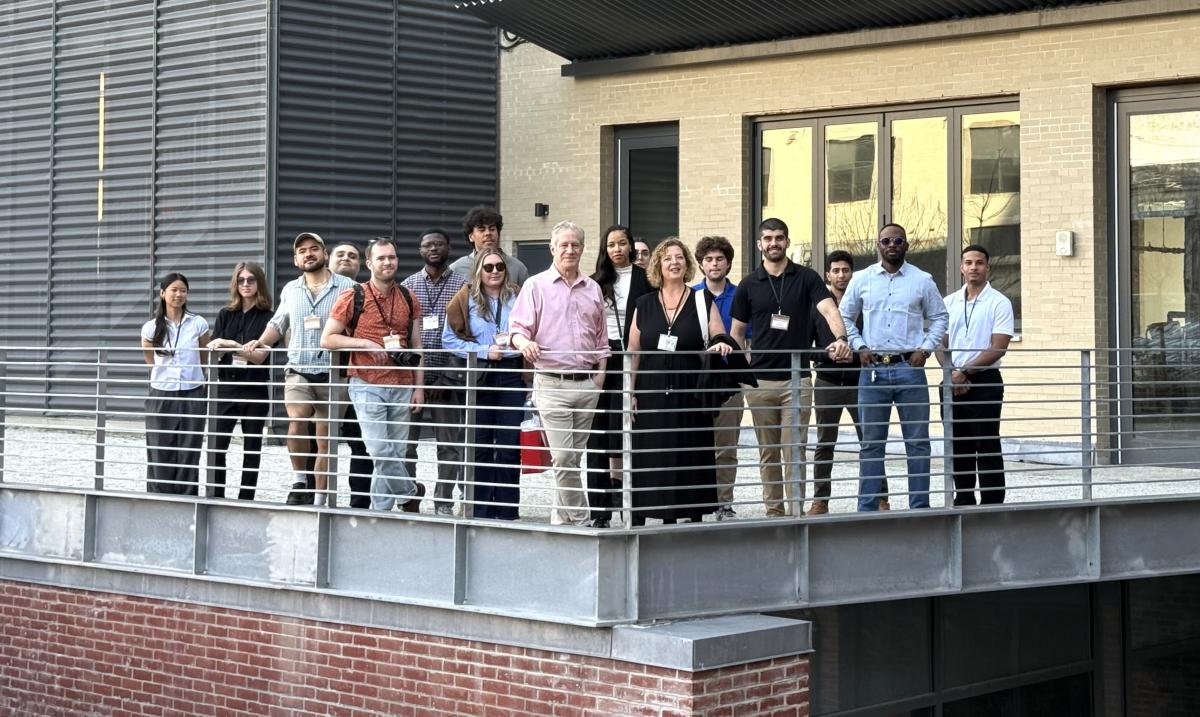
The historic red brick warehouses at West 126th St. and Amsterdam Avenue in West Harlem have been many things over their lifetime. For their first century, they were the epicenter of New York City’s burgeoning beer industry, until Prohibition officers dumped their contents into Harlem sewers in 1923. They became a cold storage facility, a laundry, and later housed the opulent furs of wealthy Manhattanites. Then, they quietly shuttered, victims of changing times and the economic turmoil that was emptying New York’s city blocks in the late 20th century.
But New York loves a comeback story, and there is no shortage of triumph in the neighborhood that is now known as the Factory District in the Innovation Triangle-West Harlem. In the same spirit of scientific (albeit sudsy) origins, the Factory District is now an innovative hub for biotech, startups, and nonprofits within the growing Innovation Triangle, just steps from Columbia University and the City College of New York/City University of New York’s Advanced Science Research Center campuses.
Behind its resurgence is Scott Metzner ‘82, the founder of the Janus Property Company, which has carved out a home—and a thriving development enterprise—in the District. In 1997, the company acquired three shuttered cold-storage warehouse buildings in West Harlem—combining them and creating the now iconic Mink Building, named for its fur storage days—which kick-started a decades-long effort to create a walkable, four-acre neighborhood of historically unique industrial buildings, brownstones and new construction, stitched together by a series of landscaped passageways and greenspace.
With iconic buildings like the Malt House and Taystee Lab Building, the award-winning Factory District has been hailed for its commitment to preservation and economic growth, while also catalyzing new energy and activity in what were once blocks of vacant properties.
“There were these spectacular hunks of buildings, but we didn’t know if we brought them back, if anyone would ever want to live or work,” said Metzner. “We’d buy one, then two, then four, and slowly it became this whole master plan of mixed-use development. Now it has everything from renowned artists to scientists curing cancer and everything in between, with plenty of potential for more.”
Metzner’s trajectory often hinged on the possibilities that come from taking nontraditional, and what some might consider, risky paths. A native of Albany, N.Y., he chose UMD for his five-year professional architecture degree after a serendipitous visit to campus on a postcard-perfect spring day when his hometown still had snow on the ground. Wanting to experience a big city after graduation, he chose the biggest; he earned an MBA at Columbia and never left. After working for a South Bronx community not-for-profit, he landed a job at what was then New York’s most progressive and influential development company.
Metzner was successful but felt a life in finance was not his calling. So at 28 years old, with little capital, development experience, or connections, he made the fateful decision to strike out on his own—amid a national financial crisis and in one of the most expensive cities in the country.
Metzner was successful but felt a life in finance was not his calling. So at 28 years old, with little capital, development experience, or connections, made the fateful decision to strike out on his own—amid a national financial crisis and in one of the most expensive cities in the country.
“That decision was just sheer stupidity on my part,” he said. “I was very young, my friends and family thought I was nuts. But there was all this exciting stuff happening in the city with housing, and I didn’t want to work in finance, and figured, if I fail at this early stage of my life, I could just go back to work.”
Named after the Roman god of thresholds, Metzner launched the Janus Property Company out of his apartment with an eye toward the largely vacant yet historically rich neighborhoods of Harlem, targeted along with the South Bronx and Central Brooklyn by then-Mayor Ed Koch for rejuvenation. Janus was one of the first companies in the country to use Federal Low Income Housing Tax Credits for its early housing projects.
“It’s stressful striking out on your own, not having a paycheck, but for me, feeling certain I didn’t want to work in a company, the entrepreneurial decision sort of made itself,” he said. “And you have to start by really learning how to learn. I started with very little knowledge of how to develop a building, and started by just walking around Harlem, the South Bronx and Central Brooklyn neighborhoods, thinking about what excited me, and that’s been my driving force since then.”
Within a decade, Janus began to expand its development portfolio, moving from smaller housing projects to large, multi-block developments to institutional mission-driven funds that had more impact. The work is complex, says Metzner; a project’s success demands input and buy-in from the community, the government, tenants, and surrounding institutions. It requires weaving the centuries of architectural and cultural histories of a place into a project, while trying to position it for the future – all of which is much more difficult than razing a site. For Metzner, that also includes taking history back to the ultimate precursor—the original pre-European wilderness of the northern half of the island of Manhattan—reintroducing swaths of landscape into a previously obsolete brick and concrete industrial district.
“One of the things I attribute to architecture school is understanding and accepting the effort it takes to do something really well versus doing something that’s average,” he said. “For me it’s really a combination of wanting to make a positive impact on this amazing neighborhood and city and feeling good about how I spend my days and, sometimes sleepless, nights.”
Over his career, Metzner has weathered events that could have easily sunk Janus: 9/11, multiple financial crises and most recently, a global pandemic; COVID-19 ground all non-essential construction to a halt, and impacted supply chains, labor, interest rates and work/life protocols. The still-unresolved effects of COVID, and now the advent of AI, have produced unprecedented disruption, said Metzner, with investors and users worried about the fate of offices and even cities themselves. But beyond always-present risks is potential—the blank page, which Metzner first discovered in architecture school, where problems are defined and solutions take shape. For Metzner, it also illustrates all there is to learn. In the uncertainty of 2026, it’s how buildings, neighborhoods and cities will be used in the future—and what might attract people to the communities he’s working hard to create.
“The single thing that makes New York City so amazing is the people here,” he said. “I try to remind myself of that. It’s what ultimately makes what I do every day so compelling and fun.”
Rapid-Fire with Scott Metzer:
Best advice you’ve ever received: Growing up, when I would complain about something or someone, my mother would ask me if I ever considered that maybe it was me, not the something or someone … it’s actually remarkably good advice.
Something you always have in your pocket (other than a smart phone): Generally a good number of keys and fobs.
Movie that makes you laugh the hardest: Wayne’s World, when Wayne and Garth are in the AMC Pacer joyously belting out Bohemian Rhapsody.
One thing you wish you knew at 19: I was pretty clueless at 19, so all of it, really. Ignorance is bliss to a certain extent.
Best book you’ve recently read or TV show you’ve binged: I’m still taken by Tomorrow and Tomorrow and Tomorrow by Gabrielle Zevin. It’s just a beautiful story that’s beautifully written.