
By Katherine Shaver
Could images of plants, waterfalls and other nature scenes outside hospital room windows help patients recover more quickly? Do specific sounds and the feel of a building’s materials improve people's focus?
Healing, productivity and even happiness can be directly connected to the spaces you inhabit, students are discovering in “Neuroscience for Architecture,” the University of Maryland’s first class to explore how the nervous system responds to building designs. Developed and taught by architecture Professor Madlen Simon and Ph.D. candidate Hernan Rosas, the course aims to help architects design buildings that orient people in space, promote well-being and offer experiences of awe and wonder.
“It’s definitely made me take a second look at things I’ve designed in the past, even how [building] materials can change people’s feelings and emotions in a certain space,” said architecture major Hailey Pavlik ‘26.
It’s part of an emerging field of research into how architectural design interacts with the brain and nervous system, similar to how “green” buildings protect the environment. Neuro-friendly architecture is worth prioritizing, researchers say, because people typically spend about 87% of their lives indoors.
Researchers at UMD and elsewhere have found, for example, that the brain responds positively to natural light, indoor plants, facades of stone and other natural materials, and color schemes that can energize or calm.
Simon was co-principal investigator on a 2021 study that measured brain activity to demonstrate how aspects of environmentally sustainable office buildings, such as natural light and views of the outdoors, also boost people’s focus and well-being.
Such findings, Simon said, might encourage clients to pay more for something like larger windows in an office building if doing so would reduce workers’ stress or boost their creativity.
“We want to be sure that architects are designing for actual human needs,” said Simon, whose home office intentionally overlooks a small patch of sunlit woods. “Neuroscience gives us a lens to train on the people who will be using these buildings, to find out how they really react to them.”
During a recent class, architecture students Antonio Lovett and Amound Lemon discussed how to best measure whether a virtual “green wall”—essentially an image of a greenery-covered wall—could speed up hospital patient recovery times as much as actual “biophilic” walls have been shown to do. Knowing that could make the case for virtual green walls in hospitals that can’t afford to maintain live plants, they said.
“Hospitals are cookie-cutter, sterile environments with no access to outdoor space,” Lemon said. “It’s been proven that people with views of the outdoors have faster recovery times. My thinking is [a virtual wall] can improve people’s recovery times or at least improve their mental state.”
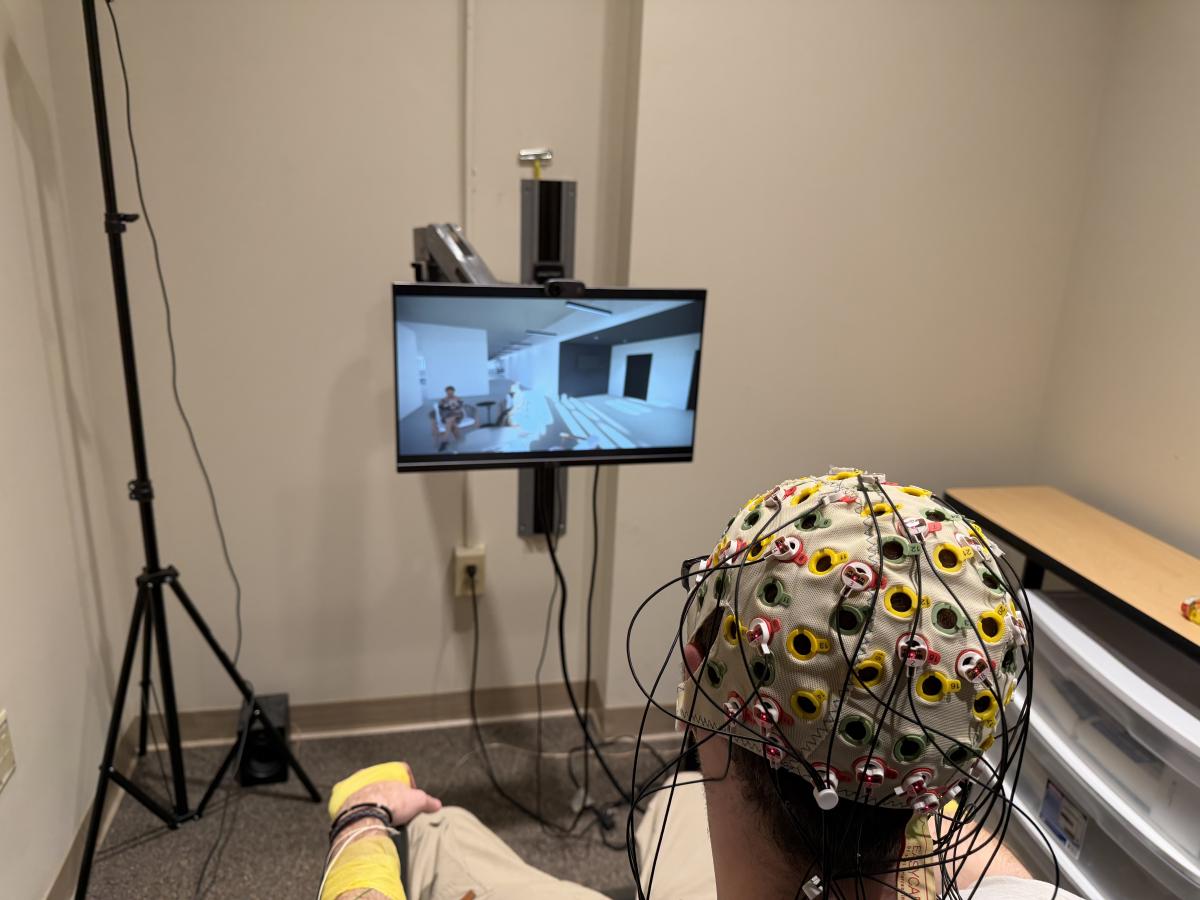
Architecture graduate students Bennett Rubin and McKaylie Morter propose measuring electrical activity in the brain using electroencephalograms to gauge people’s stress levels as they view images of a room with differing combinations of sight, sound and tactile experiences, such as fabric on the walls. Their hunch is that people are less stressed, and focus better, amid interesting sights and unobtrusive background noise than in a bare, silent room.
“The goal is to find a Goldilocks zone: a range that supports more focus and reduces cognitive load,” Rubin said.
The new class is the last for Simon, who is retiring in May. She said she’s excited about Rosas continuing the course and for him and others to build on her research.
“There’s a tremendous amount left to discover,” she said.