
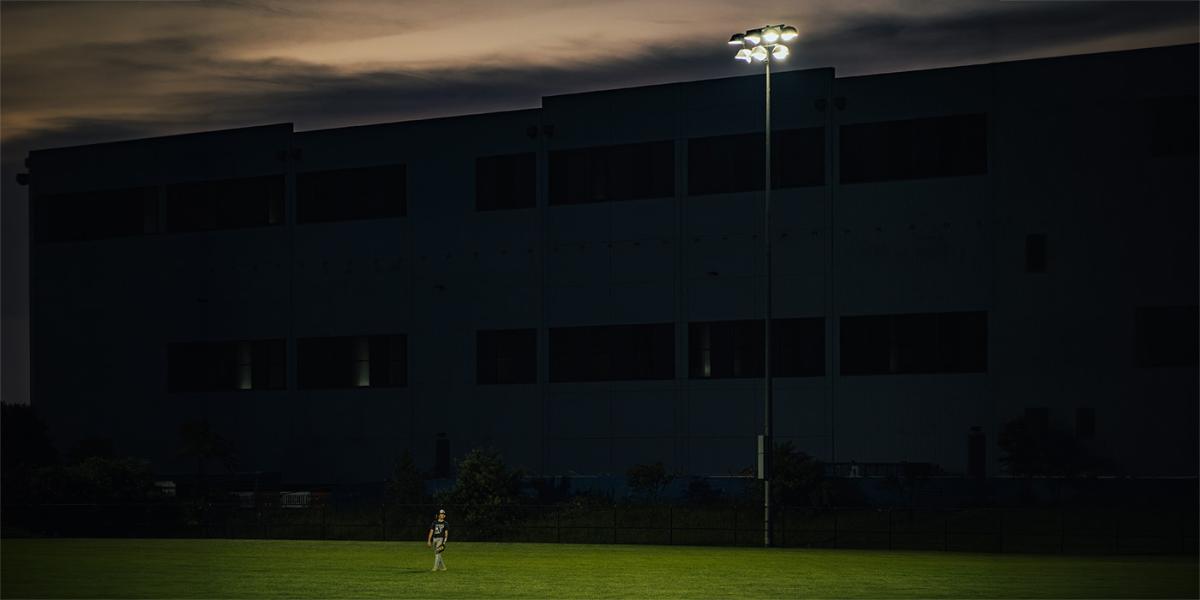
There’s a photograph on display in a new University of Maryland exhibit of a teenage boy, his baseball hat pulled low against the blinding glare of the outfield lights, pensively awaiting a line drive into center field. The iconic shot could have been taken in any American suburb, save one haunting detail: The towering data center looming just behind the fence.
“In the Shadow of the Cloud,” which opened March 4 at the School of Architecture, Planning and Preservation’s Kibel Gallery, tells the story of Northern Virginia’s rapid metamorphosis into the global epicenter of digital storage, and the price its communities pay to accommodate humanity’s voracious demand for artificial intelligence, real-time information and instant connection.
Developed by Ali Fard, a University of Virginia assistant professor and director of the Media, Infrastructure, Speculative Territories Laboratory, the exhibit encapsulates five years of research and work in communities clustered along the historic spine of Northern Virginia: the Washington and Old Dominion Trail. Dating back to the eighteenth century, the 45-mile trail now holds some of the most critical data infrastructure in the world. Once bounded by acres of farmland, the trail today is dotted with bedroom communities but also pulses with the buzz and vibration emanating from their new neighbors.
“I first biked this trail in 2021 and I wasn’t prepared for what it felt like,” said Fard. “It was really the impetus for me to dig a little deeper to understand the narrative behind the development, and the region.”
Northern Virginia’s partnership with digital infrastructure is decades old, beginning with the establishment of AOL’s headquarters in Sterling and server farms that supported early internet providers; roughly 70% of the world’s internet traffic still runs through Northern Virginia. The pandemic—and its acceleration of Zoom calls, internet shopping, social media and AI—created a second boom of data infrastructure development in the region. Northern Virginia today is home to the largest concentration of data centers in the world.
The result, says Fard, was a fragmentation within the urban fabric.
“It was a very rapid, very intense type of development,” he said. “It’s a uniqueness, speed, and intensity of development we haven’t really seen anywhere else. And with such speed, there's no communion with what else is happening in the built environment.”
The exhibit’s centerpiece is a 1:20,000 scale model of Northern Virginia, blanketed by a multimedia narrative of maps, videos, drawings and audio history to unravel the events and forces that transformed the region. Stark photography by Stephen Voss emulates the juxtaposition of the gray data behemoths and NOVA’s bucolic neighborhoods, historic cemeteries and community recreation centers.
While a sobering examination of the dark side of cloud storage, Fard’s exhibit also offers a silver lining: Models that offer creative interventions for reclaiming community and space once a data warehouse outlives its useful life, which Fard explains is remarkably short; typically these robustly fortified buildings—which require an ability to absorb a falling jet engine—only last around 20 years.
“We’re thinking ahead to a future where a lot of this data infrastructure is either underutilized, disused or abandoned,” he said. “What else could they become? Instead of fragmenting communities, could they connect them?”
In one concept, an Amazon warehouse roughly the size of three football fields is deconstructed, its frame creating a steel pergola over an elevated trail that connects a park and recreation spaces with senior living facilities. Underneath, nature reestablishes wildflowers and native plants once prolific years ago.
Kibel Gallery Director and Associate Clinical Professor Lindsey May wanted to bring the exhibit to Maryland not just because it resonates with so many disciplines, but because it repositions AI and other technologies from tools that are transforming the ways practitioners work to a phenomenon that is having dramatic, spatial impact on the urban landscapes where we live and work too.
“Ali’s work shows what designers and planners have a lot to bring to the conversation,” she said. “Our work has the power to lead public opinion and inspire people to expect more from their communities. And inquiries like this can help practitioners in the built environment think creatively and imaginatively, but also preemptively.”