
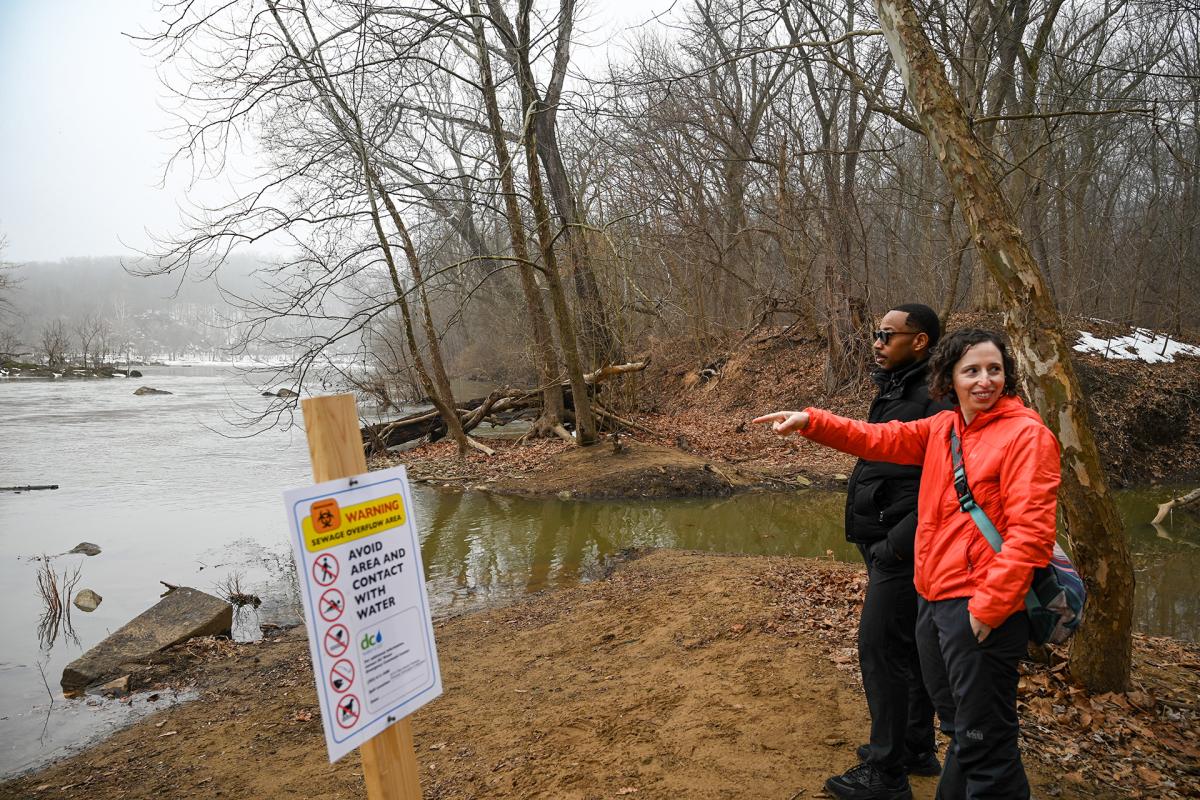
In the history of U.S. sewage spills, none has evoked a region’s collective “ick” reflex like the massive outburst of effluent into the Potomac River when a 6-foot-wide pipe broke on Jan. 19 upstream from Washington, D.C. By the time the rupture was fixed, enough raw wastewater had gushed out to fill 360 Olympic-size swimming pools.
The University of Maryland’s Grand Challenges Grants Program-funded Water Emergency Team (WET), which is led by urban planning Associate Professor Marccus Hendricks and Assistant Professor of global, environmental and occupational health Rachel Rosenberg Goldstein, was soon on the scene with students to assess the environmental and health impacts. Hendricks, who directs the Stormwater Infrastructure Resilience and Justice Lab, writes in a new essay in The Conversation that while the Potomac spill might have been the biggest ever, it won’t be the last.
In fact, around the nation, sewage spills are contaminating waterways and communities with unsettling frequency. Sewer systems are designed to be invisible. If toilets flush, most people forget they exist. This invisibility has contributed to chronic underinvestment. Pipes, pump stations and treatment facilities around the country were built in the mid-20th century and are now at or beyond their designed lifespan.
Between December 2019 and February 2020, a series of sewer main breaks in the city of Fort Lauderdale, Florida, led to the release of approximately 219 million gallons of raw sewage into environmentally sensitive waterways. In 2021, the Los Angeles Hyperion Water Reclamation Facility spilled 12.5 million gallons of untreated wastewater into Santa Monica Bay. These events were the results of various aspects of underinvestment, including deferred maintenance and upkeep, delayed replacement and capacities too low for current needs.
Read the rest in The Conversation.