
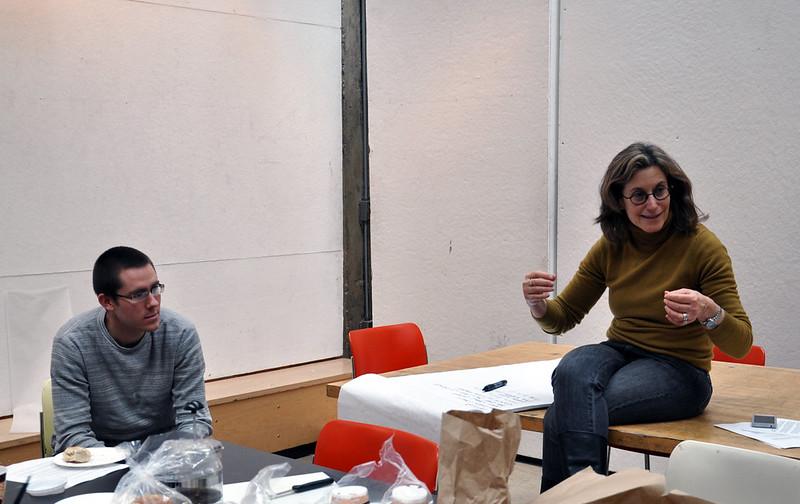
One of Madlen Simon’s biggest “teaching moments” came not as an instructor—but as a student. In 2014, she found herself approaching total strangers on the streets of San Francisco to gather ideas for a design concept as part of Stanford d.school’s Design Thinking Bootcamp, which she was attending for the University of Maryland. Simon had been a practicing architect and educator for years; she was trained to listen to clients and students. But the exercise, which tapped into deeper questions of connection, perspective and everyday experience, flipped a switch for her that would completely revolutionize how she taught her students back in College Park.
“It was engaging with someone on an almost intimate level,” she said. “[The instructors] told us, when someone gets emotional, something important is happening—and I realized, ‘Oh my god, this is it.’” 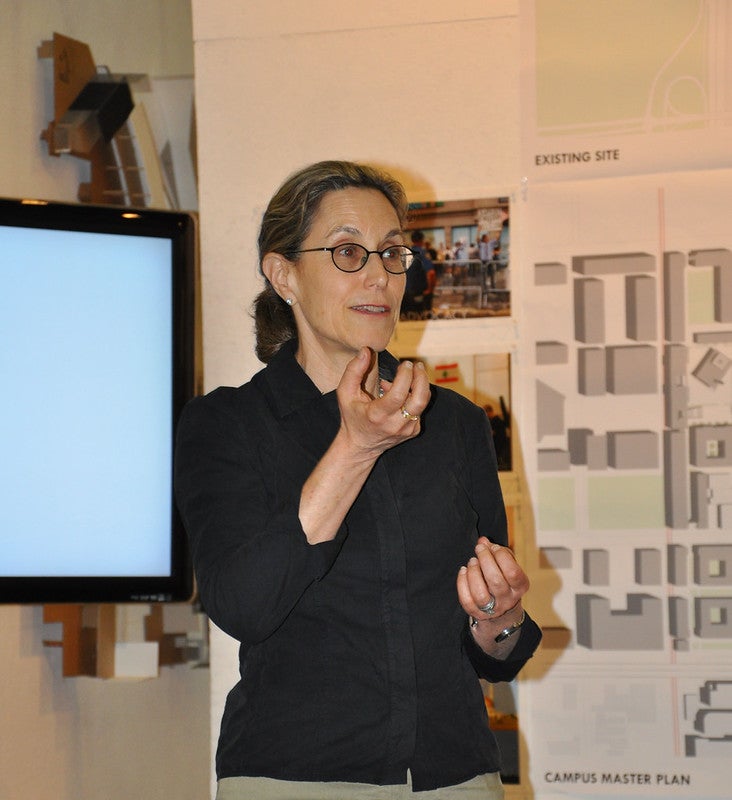
The experience encapsulated Simon’s draw to higher education in the first place; she wanted to keep learning as much as she wanted to teach. What she discovered is how they are so intrinsically connected. Simon, who retires in June after 20 years at the University of Maryland—and 35 in higher education—has spent her career absorbing the expertise and experiences of colleagues, scientists, practitioners, clients, and yes, strangers, to build a teaching model that approaches challenges with a very human lens rooted in experience.
Over two decades, she’s put her model to the test. Her students have designed and constructed cardboard chairs with no glue or fasteners. They’ve deployed neuroscience to test the impacts of different environments. They endured sweltering overnights at an Eastern Shore Girl Scout camp and designed “in-residence” alongside the stage crew at the Clarice. They have swapped selfies with college students in Iraq and covered each other head-to-toe in Post-it notes, all in the name of learning—to be good designers, but also good observers, listeners and collaborators.
“Mady incorporated a lot of empathy and creativity into her teaching approach,” said Erica Estrada-Liou, director of UMD’s Academy of Innovation and Entrepreneurship (AIE). “She was always very curious as to how she could do less lecturing and more discovery-based learning. She was quite innovative in that way.”
Simon came to UMD in 2006 from Kansas State University and quickly settled into the school’s tight-knit culture. She immersed herself in the work of her MAPP colleagues and their approaches to building craft, urbanism and sustainable design. After becoming program director in 2008, Simon made it her mission to increase the visibility of their profession and practice on a campus steeped in academic research and scholarship. She engaged with the university’s Center for Teaching Excellence, and later, the AIE, which funded Simon’s work to develop courses that would engage not only architecture students, but all UMD students, through a widely applicable skill called design thinking: a people-centered, empathy-driven approach to problem-solving.
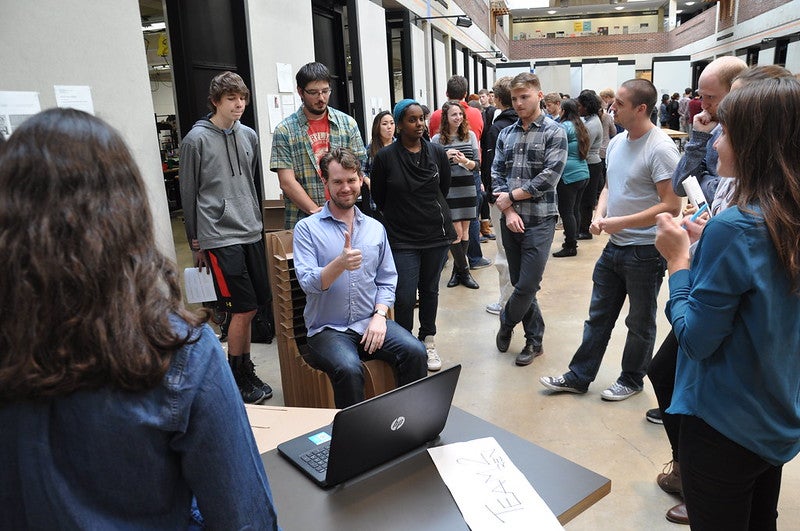
“It’s what we do in studio every day,” she said. “And this was an opportunity to share our form of design education that I value so highly.”
She was one of the first faculty on campus to launch a Fearless Ideas course for the gen-ed curriculum. After attending the Stanford d. bootcamp, she returned as an alumni-in-residence to share ideas and coach her colleagues.
“She was a standout, even in the design crowd, as someone who could lead other faculty and help them try new things,” said Estrada-Liou. “I learned a lot just by seeing how she’d set up her classroom in a way to encourage student collaboration.”
Over her career, Simon has amassed over $50,000 to develop coursework at UMD grounded in experiential, interdisciplinary learning, both through the architecture program and UMD’s iSeries, a specialized gen-ed initiative to engage students in interdisciplinary, real-world problems. She brought experiential learning into the classroom through unconventional means, from real clients like NASA, the Girl Scouts of America and Glen Echo Park to study abroad opportunities, and global classrooms including her acclaimed, decade-long “Bridging the Gap” studio, which paired UMD students with Iraqi students from Al-Nahrain University. Bridging the Gap won Architecture Magazine’s prestigious Studio Prize in 2019.
As Associate Dean for Academic Affairs and Outreach and in her faculty role, she’s built unique partnerships with institutions, design firms, universities around the U.S. and the world, and colleagues across campus, enriching the student experience and challenging them to explore problems from different angles and perspectives. After the hot and buggy night at the Girl Scout camp, her students spent an afternoon engaging real Girl Scouts in a workshop. At the final project presentation, a young man in her class declared, “Now I’m a Girl Scout.”
“I hope that if there’s something I leave behind it’s that kind of teaching, where students really take the time to understand who they are designing for,” she said. “How do you engage people who aren’t like you? I think it’s something that tends not to be taught.”
In 2019, she and her colleague, former UMD Associate Professor Ming Hu, brought together experts in virtual reality, design and neuroscience to better understand the cognitive impacts of sustainable design on productivity, mood and health. The research resulted in new partnerships on campus and beyond, a published paper on the impacts of sustainable design on cognition and this past year, a new course on neuroscience for architecture.
“It’s all very well to design sustainable buildings, but if people don’t like them, they won’t get built," she said. “So, it really creates scientific buy-in. And it was such a fantastic team; none of us could have individually done this ourselves.”
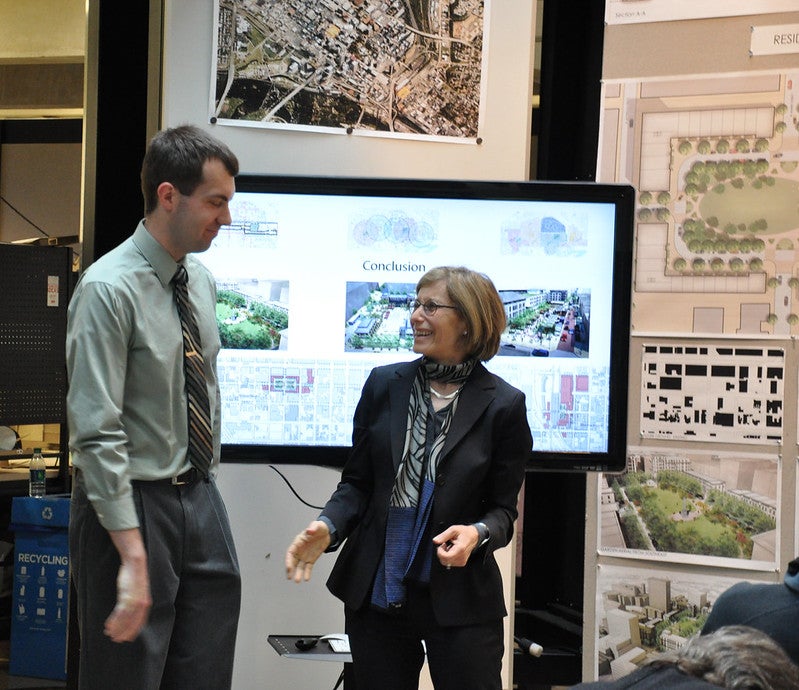
Simon’s work has continued to bring her recognition. The AIE named her a distinguished fellow in 2014, and she earned the prestigious Kirwan teaching award in 2023. In June, she was elevated to the AIA College of Fellows.
But her legacy, she says, are her students— she has mentored nearly 100 over her career. Last year, she established the first faculty-sponsored, needs-based scholarship for undergraduate students, ensuring that legacy continues long after she's gone.
"Mady helped shape my experience as both a professor and director,” said former student Joseph Kunkel M.Arch ’09. “Her commitment to design education, critical thinking, and student engagement has influenced generations of architects, planners, and designers. I am grateful for her support over the years and for the opportunity to return and share my work with her students.”