
This article originally appeared in Maryland Today. Written by Fid Thompson.
University of Maryland researchers have detected high levels of fecal-related bacteria and disease-causing pathogens in the Potomac River following a massive sewage spill, raising urgent public health concerns and underscoring the risks posed by aging sewer infrastructure.
Water sample results collected at the site by researchers and students show high levels of E. coli are present along with Staphylococcus aureus (the bacteria that causes Staph infections). An antibiotic-resistant strain of S. aureus, MRSA, was also identified at the site of the Jan. 19 sewage overflow from a ruptured pipe, estimated at some 300 million gallons.
“People coming into contact with the impacted water or land are at risk of becoming infected with these bacteria, which can lead to serious health conditions,” said Rachel Rosenberg Goldstein, microbiologist and assistant professor at UMD’s Department of Global, Environmental, and Occupational Health. “Although most people are not swimming in the frozen river in February, bacteria can survive in freezing temperatures and become active again when temperatures rise.”
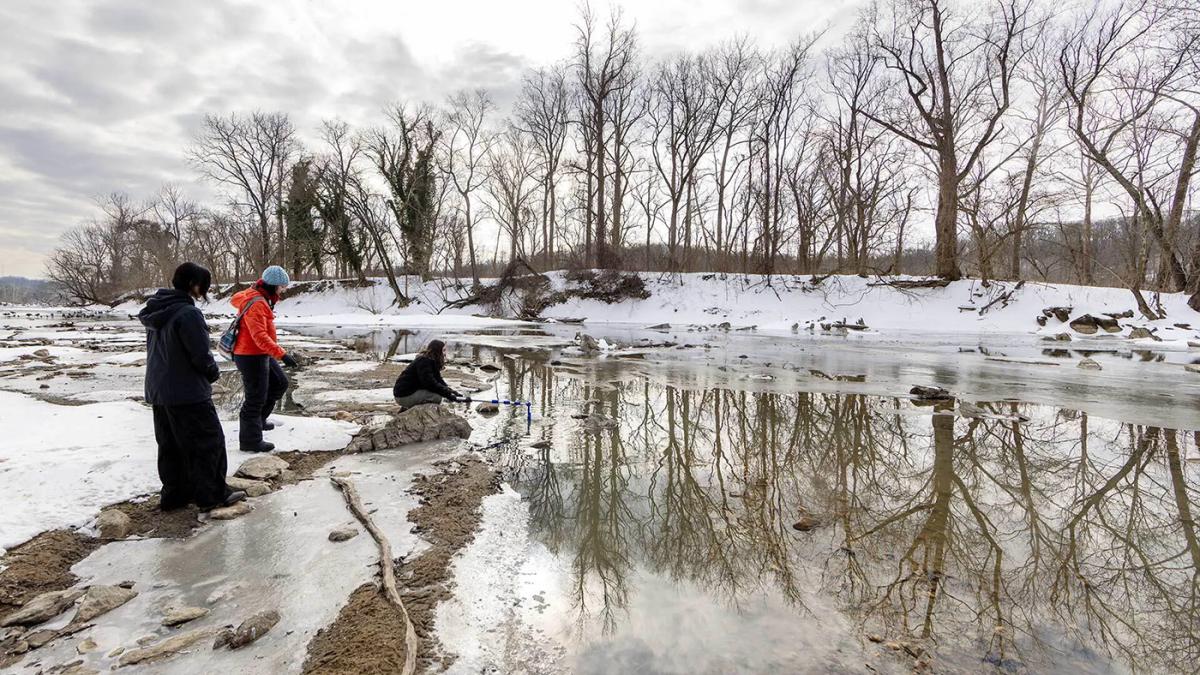
Goldstein’s Water Quality, Outreach and Wellness Lab (WOW) went directly to the source and other sites downriver to test the water for fecal-related bacteria and pathogens shortly after the gushing began. The team returned one week later with members of the Potomac Riverkeeper Network to take more samples.
E. coli samples the team collected where sewage entered the Potomac were over 10,000 times above EPA recreational water quality standards. On Jan. 28 samples at the site were lower, but still over 2,500 times above water quality standards. At a site over 10 miles downstream on Jan. 28, E. coli were 1.5 times above the standard.
The team detected Staphylococcus aureus on Jan. 21 and 28 where sewage entered the Potomac and at a site nine miles away. Of the sites sampled, 33% were positive for S. aureus, higher than found in other surface waters containing this bacteria. An antibiotic-resistant strain of S. aureus, MRSA, was also identified at the site of the sewage overflow.
People near the spill site in Maryland, Washington, D.C. and downstream should avoid contact with impacted river water and land until E. coli levels meet water quality standards again, said Goldstein. For people who come into contact with impacted water or soil, she recommends washing skin with soap and water or an alcohol-based sanitizer and washing clothes with detergent at the warmest temperature and machine-drying them.
Goldstein and Marccus D. Hendricks, associate professor of urban studies and environmental planning at UMD, co-lead the WET project, a UMD Grand Challenges awardee and joint venture between the WOW Lab and the Stormwater Infrastructure Resilience and Justice (SIRJ) Lab.
Studies by Hendricks’ SIRJ Lab in Washington, D.C. show that above-ground development in the city has outpaced stormwater and sewer infrastructure development, likely straining the capacity of outdated systems that need significant and ongoing investment.
“This issue isn’t going away—solving the recent Potomac spill is not a simple one-time fix,” said Hendricks.