
Written by Katherine Shaver
Commissioned by President George Washington to design the new nation’s capital, Pierre Charles L’Enfant initially proposed a massive “President’s Palace” surrounded by sprawling grounds—an imposing complex four times the size of today’s White House property.
It didn’t take long for Washington and others to realize the poor optics of a “palace” for a democratic republic that had just fought off a British king. The scaled-back building that opened in 1800 was renamed the “President’s House.”
The White House (its name as of 1901) and its grounds have been morphing ever since as it accommodates the shifting needs and desires of its occupants.
Change is once again in the news with the October demolition of the East Wing, part of President Donald Trump’s intention to build a much larger ballroom that historic preservationists say would dwarf the iconic residence. The plans face a federal lawsuit from the nonprofit National Trust for Historic Preservation, which is seeking to block construction until the public and experts have been allowed to formally weigh in.
Watching from the sidelines is Jonathan Pliska M.H.P. ’07, a landscape historian who documented the history of the White House grounds for the National Park Service and wrote about them in the 2016 book “A Garden for the President.”
As a historian, Pliska said, he sees how the current controversy underscores a centuries-old tension between change and continuity—a tension that has long transcended partisan politics.
“There’s a yin and a yang,” said Pliska, who serves on the editorial board of the White House Historical Association’s print journal, White House Quarterly. “Whether you're red or blue, Republican or Democrat, the grounds are green.”
Below, Pliska shares five significant changes to the White House and its grounds over the past 225 years. (One little-known change avoided: During World War II, President Franklin D. Roosevelt turned down a request from the military to repaint the White House in camouflage.)
Smokehouses and toilets: Beginning in 1805, the White House’s second occupant, President Thomas Jefferson, expanded the Executive Mansion by adding the East and West Colonnades. The new structures housed a dairy, smokehouses, horse stables, storerooms and other facilities needed for daily living. Another bonus: Indoor toilets replaced outhouses. They remained until 1866, when President Andrew Johnson ordered the dilapidated East Colonnade torn down. The move was controversial, Pliska said, because, even at only 66 years old, “The White House had become iconic.”
A “tropical paradise”: President James Buchanan built a large conservatory above the West Colonnade in 1857. Filled with exotic plants of all kinds, the glass house became a tropical paradise, Pliska said, and more greenhouses were added over the next four decades. In addition to growing flowers for White House events, the Conservatory and greenhouse complex provided a private place for presidents and first families to relax and entertain, away from the crowds then free to roam the grounds of what had become known as the “People’s House.”
Expanding workspace: In 1902, President Theodore Roosevelt had the Conservatory and greenhouse complex demolished to make way for larger staff offices in what would become the West Wing. Roosevelt also had the East Colonnade rebuilt as a new visitor’s entrance. During World War II, President Franklin D. Roosevelt expanded that colonnade to provide office space for military personnel. It eventually became the East Wing, serving as a social entrance and housing offices for the first lady, until it was razed in October.
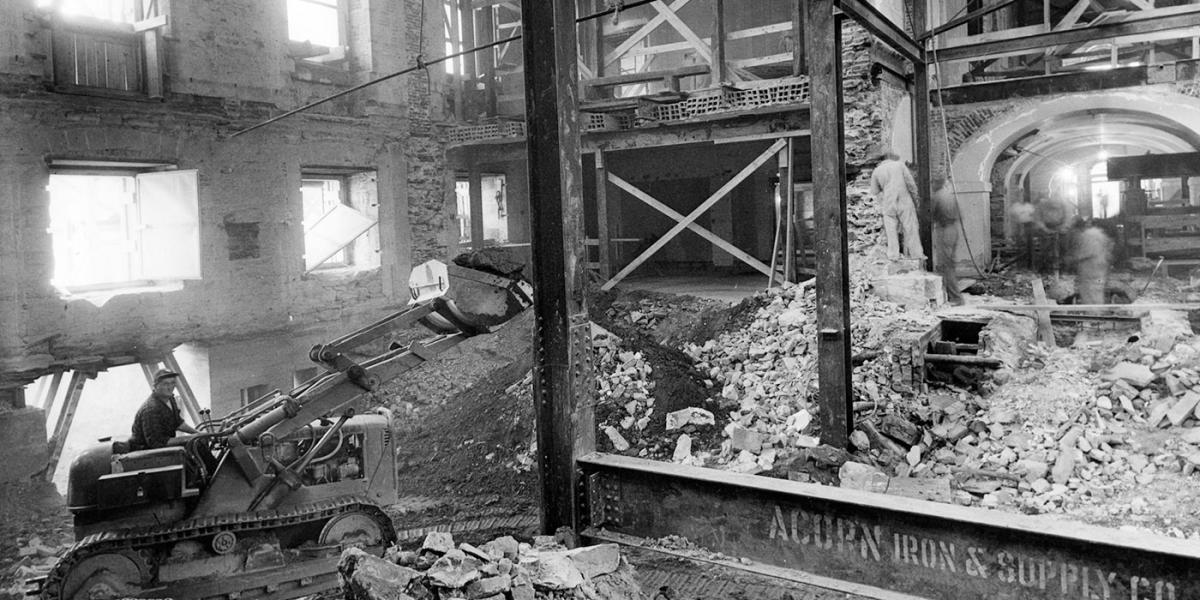
Down to the studs: Starting in 1949, President Harry S. Truman had the then-150-year-old White House gutted while he and his wife, Bess, lived at Blair House across the street. The project had its opponents, Pliska said, but the extensive renovation modernized the White House and saved “bits of it that were actively falling down.” Though photos of a bulldozer inside the White House probably shocked the public, Pliska said, “we would not have the White House we have today without the Truman renovation.”
No more picnics: In its earliest days, the White House grounds were a public park, where hundreds of people strolled and relaxed over picnics. President Abraham Lincoln closed the gates temporarily as a security precaution during the Civil War, but the grounds otherwise remained fully accessible for decades. The gates weren’t locked overnight on a continuing basis until the administration of President Ulysses S. Grant, when “a man and a woman were supposedly caught doing something inappropriate in the bushes,” Pliska said. President Grover Cleveland cut off unfettered public access in 1893. The Clevelands cited the safety and privacy of their young children, including “Baby Ruth,” whose name ended up on the candy bar.
U.S. presidents have altered the White House for their personal enjoyment, including:
- 1878: President Rutherford B. Hayes removed the first ornamental water fountain to build a croquet court.
- 1933: Under President Franklin D. Roosevelt, an indoor pool was built where the president could swim as therapy for his polio. (It got covered over to build the press briefing room in 1970.)
- 1975: President Gerald Ford, an avid swimmer, had an outdoor pool dug and cabana built.
- 2009: President Barack Obama had basketball court lines added to the tennis court.