
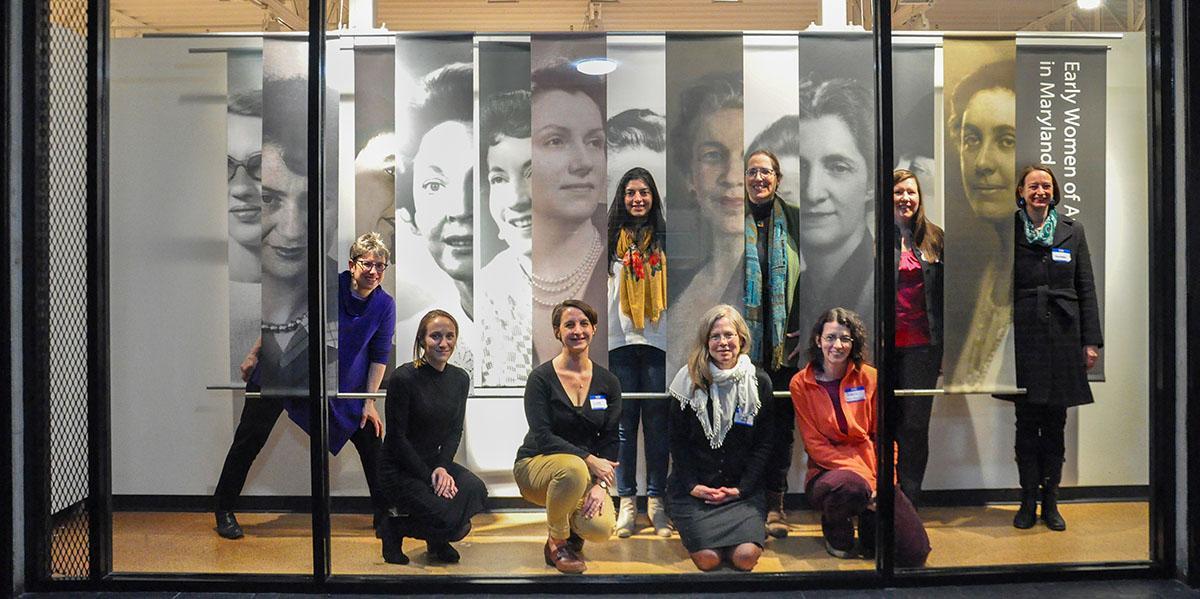
On the ground floor of the University of Maryland’s Architecture Building, just beyond the buzz of its design studio and trademark red brick, sits a glassy, serene space of whitewashed concrete and steel. When empty, it’s a bright, blank canvas—but it’s rarely empty. Over the years, MAPP’s Kibel Gallery has showcased world-renowned architects and emerging young talent; fostered conversations on topics like housing equity and memorials; and challenged visitors to ask questions and rethink past perceptions.
Twenty years ago this month, MAPP rededicated the Architecture Building’s long-running exhibition space as The Kibel Gallery. Funded by a gift from the family foundation of architecture alumnus Charles Kibel (M.ARCH ‘90), the newly renovated space launched a fresh direction for the gallery’s programming through original installations and visiting exhibitions. The Kibel Gallery is one of five galleries on University of Maryland’s campus; its parade of programming—from professional exhibitions and symposia to showcases of student work and community receptions—reflects the creative activities of Maryland’s built environment school. Under the care and leadership of the gallery’s Founding Director, Professor Ronit Eisenbach, the gallery grew from a supporting role within the school into a leading character, advancing the school’s mission, building new partnerships and uniting different disciplines around the challenges, complexity and beauty of the built environment.
“The Kibel Family's support of the gallery has enabled the school to mount extremely successful and ambitious exhibitions that have elevated the work and reputation of the school,” said Professor Brian Kelly, who directed the Architecture Program during the gallery’s first twenty years. “Through the guidance of Professor Eisenbach, who oversaw operations in the Kibel Gallery, the quality of exhibitions attained a new level of professionalism.”
There have been over 60 exhibitions at the Kibel, many curated and designed by Eisenbach or co-designed with students or/and faculty, and all carefully paired with lectures, gallery talks or symposia; roughly half highlighted the achievements of women and people of color. While MAPP is not the only design school to host a gallery, there are aspects that set the Kibel Gallery apart: most notably, that it’s open to the public.
“The gallery is this sacred and accessible space for us to create and learn, but also for the public to engage with that creative expression,” said Eisenbach, noting the many times she has encountered people outside the MAPP community taking in an exhibit. “The gallery gives us the opportunity to shed light on topics and designers not covered in the coursework and spur important conversations and collaborations across disciplines, demonstrating what we do at MAPP and its relevance.”
While Eisenbach has designed shows for big names like mid-century designer Ruth Adler Schnee and original exhibits like last year’s "Making the Holodomor Memorial: Contexts and Questions," she says that the Kibel is, above all, for the students, whether as a learning laboratory, a place for quiet contemplation or a spark of inspiration.
“It’s the same space, but each exhibit we created looks and feels so radically different,” says Eisenbach, who stepped down as director in December. “We’re a school that thinks through making, and the Kibel Gallery is a special place to do that.”
On the Kibel Gallery’s 20th Anniversary, Eisenbach looks back on five exhibitions that stand out:
“Places of Refuge: The Dresser Trunk Project” (2009):
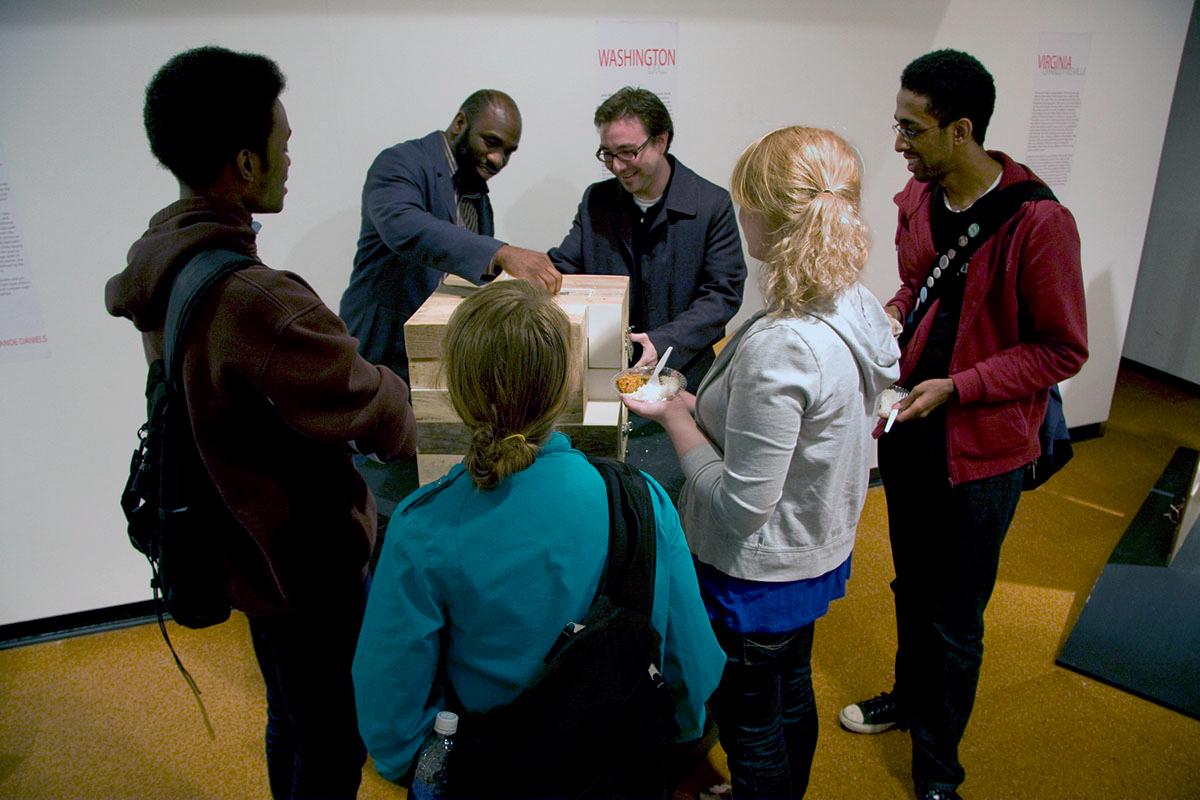
While the Kibel Gallery debuted dozens of original exhibitions over the years, it also featured traveling and borrowed ones: one of those was the “Dresser Trunk Project,” a multimedia show that depicted the stories, memories and places of refuge for Black travelers in a segregated South. Curated by architect and professor William Williams, the exhibit featured 11 “trunks” created by 10 young Black architects, each marking a different place of refuge along the Southern Crescent Railway Line, a major migration pathway between the American North and South. The exhibit, says Eisenbach, made visible the injustices and histories overshadowed by racist practice. “It challenged people to think more deeply about our built environment—who created it, who it is for, who it ignores. It’s an example of how the gallery served as a vehicle outside the classroom that brought important issues and discussions to the fore.”
“Ruth Adler Schnee: A Passion for Color & Design” (2009)
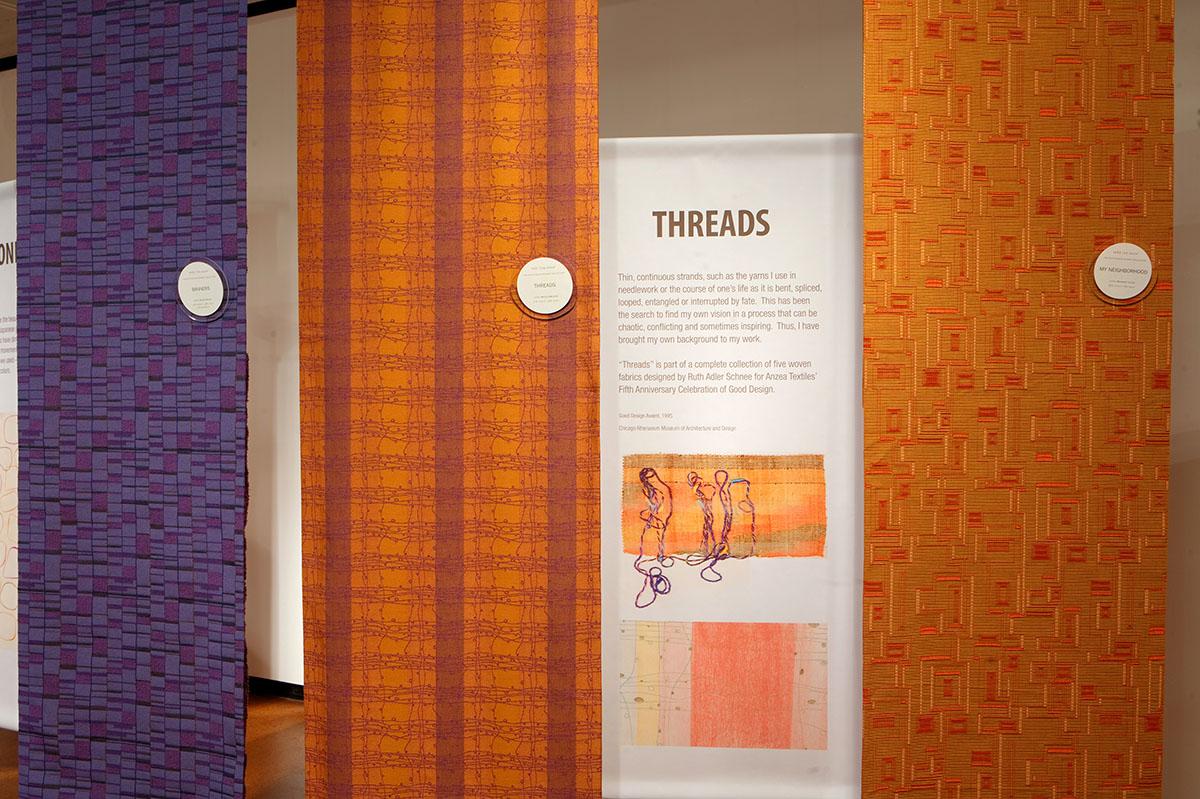
This MAPP-curated exhibition of Detroit-based textile designer and architect Ruth Adler Shnee (who passed away this month) was paired with a lecture by Schnee and an early screening of Terri Sarris and Eisenbach’s film, “The Radiant Sun: Designer Ruth Adler Schnee,” documenting her life and contributions to the mid-century modern movement. Architecture alum Jessica Green Quijano (M.ARCH ‘08) spent three weeks scanning hundreds of Schnee’s sketches to share the iterative process of bringing a design to life. “It was so valuable for our students to see how each fabric design evolved from these early inspirational objects, to sketches, to a silk-screened fabric pattern and, finally, woven fabric,” said Eisenbach. One of the gallery’s most popular exhibits, the show traveled to Venice’s Museo di Palazzo Mocenigo and helped catapult Schnee into the national spotlight.
“Lina Bo Bardi: To Teach is to Construct” (2015)
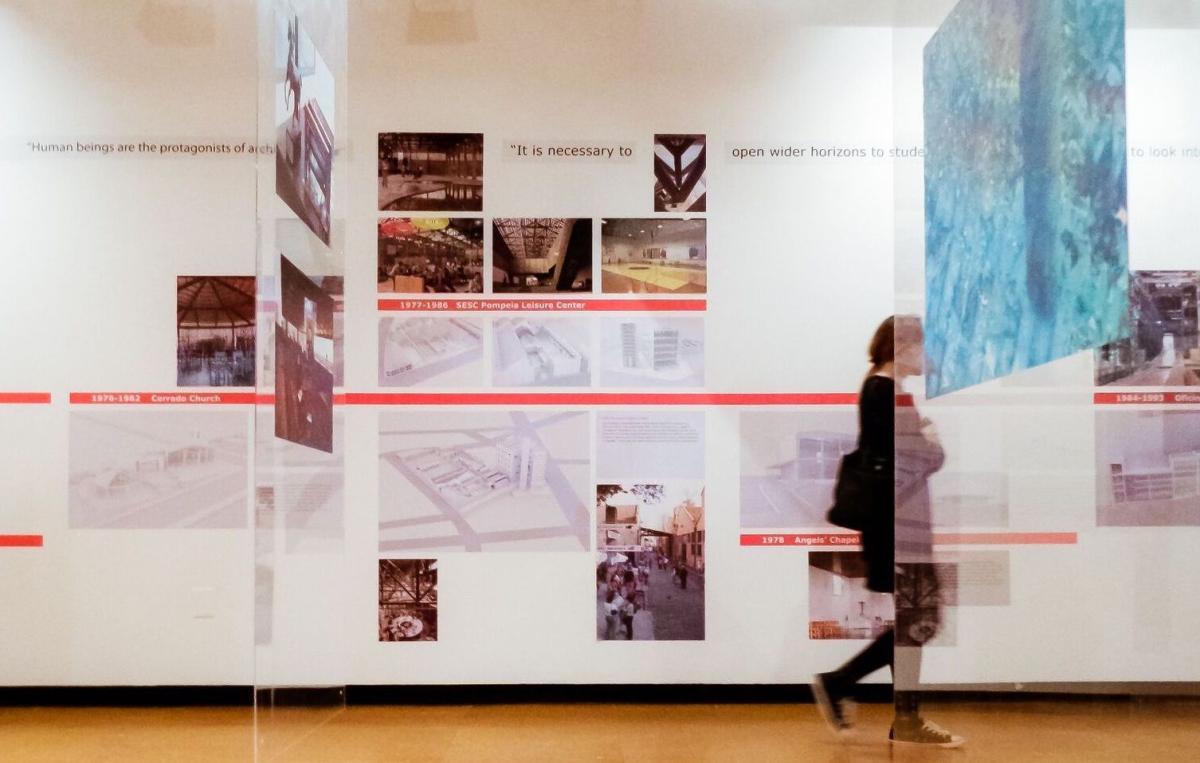
Throughout Eisenbach’s education, professional practice and teaching, she had never learned about the architect Lina Bo Bardi—so when she was finally introduced to her work, she was stunned. Born before WWII in Italy and later moving to Brazil to practice and teach, Bo Bardi was a successful graphic designer, architect and teacher despite the immense obstacles she faced in a male-dominated discipline. “No one on the faculty had ever heard of her, but she had designed ground-breaking buildings, objects and exhibits,” said Eisenbach. “When I was in school, architectural education just didn’t feature women architects.” The exhibit, curated and designed by Eisenbach, graduate student Russel Holstine (M.ARCH ’16), Brazilian Architect Denise Hochbaum and Professors Zeuler R. Lima and Cathrine Veikos, displayed Bo Bardi’s treatise on architecture education—the first ever written by a woman—a timeline of her prolific work and a series of floating displays of her often-whimsical drawings, reminiscent of an exhibition Bo Bardi had done decades earlier. The exhibit also forged meaningful partnerships with the Italian and Brazilian embassies, as well as other schools on campus.
“MAPP at 50” (2018)
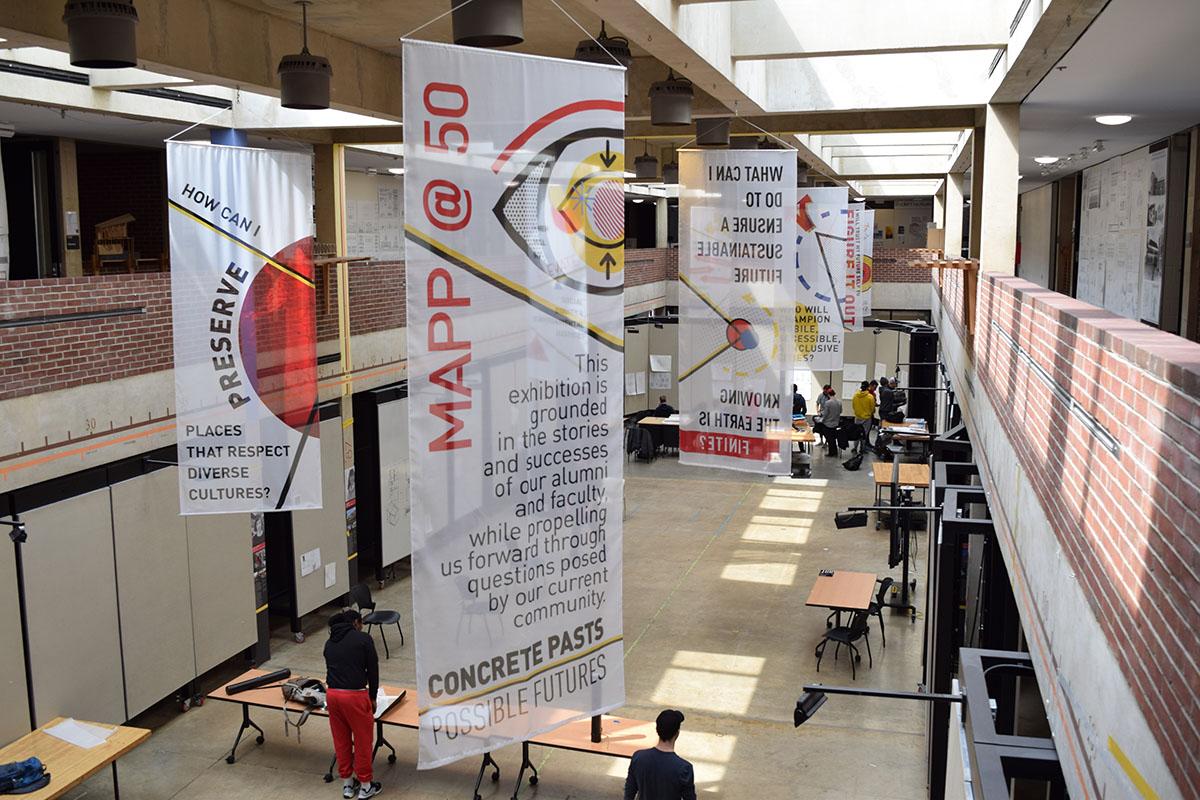
By the end of The Kibel’s second decade, exhibitions began migrating beyond the confines of the gallery, from “Chamber,” a gigantic anechoic spherical capsule installed in the Parren J. Mitchell Art-Sociology Building atrium to “#nothingisordinary: photos by Cindy Frank,” (M.ARCH ‘87), posted on the Architecture Building’s concrete columns. But it was the occasion of the school’s 50th Anniversary that inspired an exhibit that went beyond marking its past by charting its future. Inspired by a series of conversations and workshops with faculty, staff and students—and led by the gallery team and Artistic Director of Dance Exchange Cassie Meador—10 questioning statements were emblazoned on large fabric banners, a reflection of the community’s hopes and a charge for the next half-century. The colorful statements served as a north star for MAPP’s community and seeded the tenants of its strategic plan in 2019; they loom large over the Great Space to this day. “I became more and more interested in the idea of spatializing content,” said Eisenbach. “How do you create experiences in our everyday spaces that offer and invite people to notice, be curious and inspire action?”
“Sustenance and Sustainability: Sparking Dialogue, Shifting Culture” (2019)
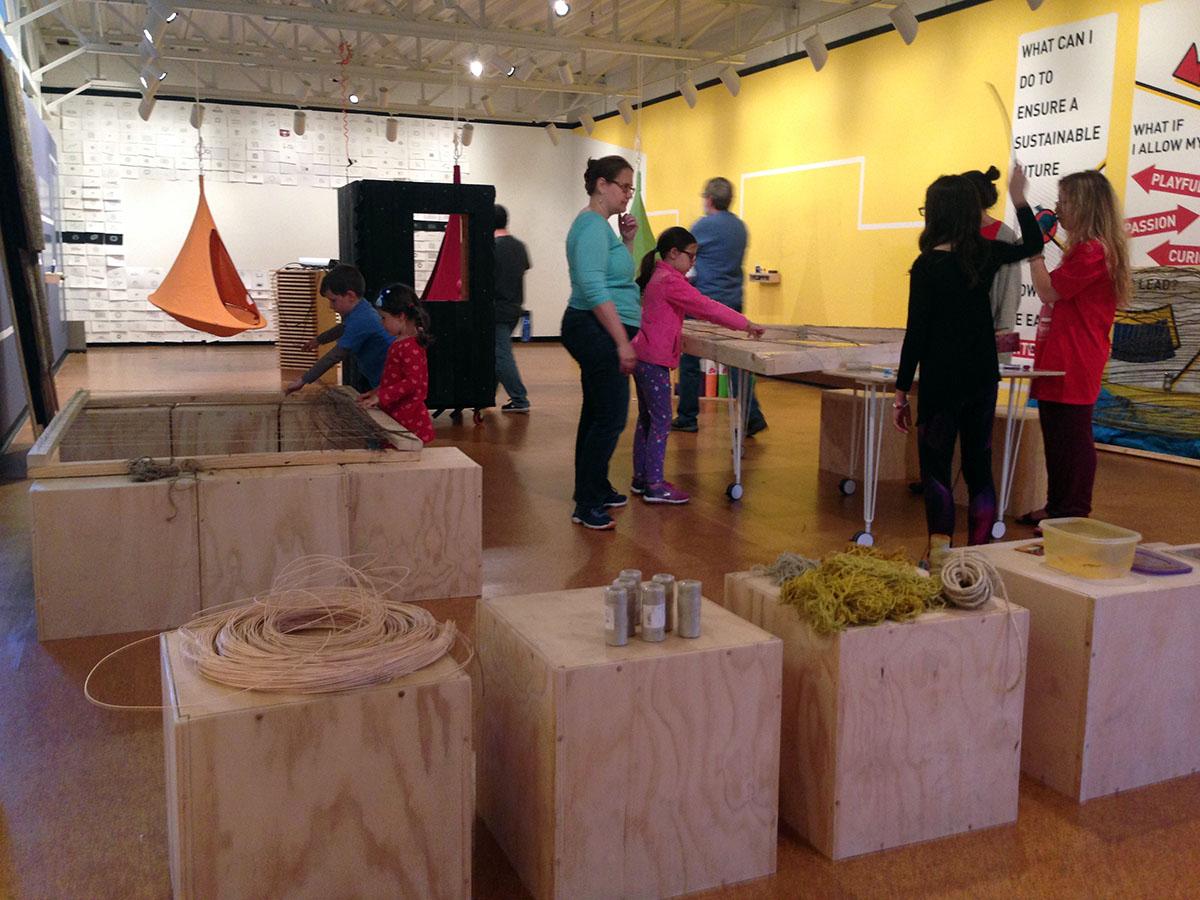
After a planned exhibit was unexpectedly canceled and faculty learned that students were feeling particularly stressed, Eisenbach, alongside clinical faculty Andrew Linn and Julie Gabrielli and gallery assistants Heather Summers (M.ARCH ‘19) and Eric Bos (M.ARCH ‘19), transformed the gallery into a refuge for faculty and students, while simultaneously serving as an immersive teaching space on the topic of sustainability. Gabrielli and Linn’s classes were taught among individual cocoon hammocks hung from gallery trusses, with walls serving as whiteboards for iterative sketching and ideas around sustainability. “This exhibit evolved and grew over the semester.” said Eisenbach. “We realized we had people in different classrooms talking about these issues but had no idea what anyone else was saying. The idea was to position the gallery as a place not just for looking, but for collecting materials around a topic and activating conversations.”